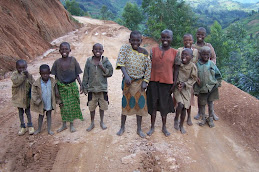
Rwanda is short of more than 3000 classrooms for the start of the next academic year in January 2010. This is how the country is going to solve the problem, using the army, parents, prisoners and engineers. Are there some lessons about local involvement which we could learn in England?
The Minister of Education, Dr. Charles Muligande, has emphasized the need for parents’ participation and commitment towards the campaign to build more classrooms ahead of the 9 -Year Basic Education programme in 2010.
According to the Minister, all parents should take up this challenge so that the needed number of classrooms can be available by the start of the academic year.
The 9 -Year Basic Education programme is a pledge made by President Paul Kagame during the 2003 presidential campaigns where he promised that every Rwandan child would have chance to study the first nine years for free.
As the next academic year approaches there is need to build 3,172 classrooms if the programme is to succeed.
“We initially needed over Rwf30 billion for the classrooms, but we managed to secure less than Rwf10 billion from our budget.
That is why we had to look for other alternatives like involving the people around the schools to help us,” said Muligande.
According to the plan, the ministry would avail raw materials and technical support, where an engineer in every district will be availed and a technician on every site and the locals would provide the man power.
The State Minister in charge of Primary and Secondary Education, Mathias Harebamungu, told this paper that so far 14 districts had received the needed raw materials whose transportation had been carried out by the Ministry of Defence, a stakeholder in this programme.
He also said that people’s response towards this was still positive despite more need to stimulate them more.
There will also be need to use services like TIG and parents making some financial contributions to make this programme a success.
Tuesday, 15 September 2009
How to build 3000 classrooms in a hurry.

Postcards from last week in Nyabinoni

Late afternoon sun on the mountainsides.

Tharcisse, the head at Bubaji, in his office. It's also the staffroom and school store room. Bubaji is the school which ranks almost bottom in our Muhanga "league table" and by any standards has been a failing school for the past three or four years. Tharcisse has quite a job on his hands to try to rescue it.

The lovely little lane which leads up the mountain to Bubaji school.

Late afternoon light looking westwards towards Goma and Gisenyi.

The priests' living room at Nyabinoni presbytery.

Looking across to Karisimbi volcano over the roofs and water tanks of Nyabinoni school. While we were looking at it from a distance, a big bunch of VSO girls was just setting off to climb it!

This is the view from the church porch at Nyabinoni. Karisimbi once again in the background. About half past six in the morning.

Posing with some friends on the way back from Mass. Seven o'clock in the morning.

View from the road near Gisura school (which we didn't have time to visit).

The meeting point of the Nyaborongo and Mukungwa rivers. You can see the different colours in the water!

Another shot of the meeting point of the Nyaborongo and Mukungwa rivers.

Kibingo school - the very furthest point in Muhanga from Gitarama. The river flows just behind the buildings.

Typical log bridge on the main road.

A typical small village centre on the main road between Ngaru and Kibingo. If you live right out on the mountainside in a family farm, then this place is nearest approach to "civilisation" you're going to get....

View from the metal bridge at Kibingo, looking down the Nyaborongo gorge. Compare the width of the river here with the picture next but one below - here it's only half as wide but very deep and very fast. The river here must be seriously scary at the height of the rainy season!

Cycle delivery men with sacks of cassava on the metal bridge that goes from nowhere much to nowhere at all, near Kibingo!

The wide Nyaboronog just beyond the confluence. You can see the muddy and clear waters starting to mix here!

The staff at Ngaru primary school.

Pupils and teachers at Ngaru. Donatelle, the brilliant teacher in yr 2, is 5th from the left, half hidden behind a pupil.

The view up the Mukungwa river valley from the playground at Ngaru school.

Rice fields next to the river. When the morning sun is on them they absolutely gleam the brightest green you've ever seen.

A nice moody shot of the Nyaborongo in late afternoon light.

The building blocks of rural life in Rwanda - 1. A typical chunk of mountainside between Bubaji and Nyabinoni. While Soraya and I might rave about the scenery, the reality of life for the families who live here is harsh. Steep slopes, no amenities, deteriorating soils, and no fresh land left to cultivate. Well, would you endure these conditions if you could move to an easier life somewhere else?

The building blocks of rural life in Rwanda - 2. A close up of two of the smallholdings in the previous picture. Look how steep the slopes are, yet there's not a terrace in sight. How much of his soil will the farmer lose each year during the heavy rains?

Rural life - exercise books in one hand, hoe in the other. This lad is off to school at six in the morning, via the family fields; there's time for an hour's hoeing before school starts.
Ultima Thule in Muhanga District
September 10th
I wake up to the blasted guard’s radio again. It’s a beautiful morning, ideal for photography, so I decide to go up with Bosco to morning Mass. Soraya comes too. Last year when we came here the church was a building site. It’s still not complete, but almost there. Building work is focusing on the new Presbytery being built alongside the church.
Inside the church is like a hangar. The brick walls are enormous; it’s far bigger than the cathedral at Shyogwe. There is bunting decorating the metal beams that support the tin roof. There’s an enormous unobstructed central space. The building is light and airy, and the furniture – altar, cupboards etc – are tasteful. The altar is a flat slab of stone supported on a curved structure clad in local stone from the river beds. It is very effective and remarkably tasteful. I’m just realising I never took a picture of the interior, but never mind. Perhaps Soraya did.
The service is short and formal; the singing lively and accompanied by a drum. Unfortunately the building is so big and bare that the acoustics aren’t good. They need some fabric wall hangings to absorb the sound and give the resonance more warmth. The people are the same as last year. Schoolchildren, in uniform, are in church on their way to school, their textbooks placed on spare benches at the rear. Peasants, some on crutches, leave hats and hoes at the door (but just inside the church this year rather than outside, as last year – perhaps someone has been pinching their tools while they pray). A couple of toddlers break free, and today more exciting than even watching the drummer is the chance to goggle at two muzungus.
After breakfast Soraya and I saddle up with Jéremie and Bosco and head off deeper and deeper into Nyabinoni. Today I’m “off on one”. I’m going to the two furthest out schools of all, Kibingo and whichever of Gisura and Ngaru turns out to be the school at the bend of the river. (It turns out to be Ngaru, so Gisura misses out. Sorry, Gisura, but you are an Anglican school so perhaps Michael can get out to you). We stop at Gisura on the way, but by that point I’ve made up my mind where I want to go. I’m on a geological away day as well as visiting schools, and I don’t care!
I try ringing Kibingo to ask if it’s OK to visit them today, but the school is deep in a gorge-like section of the Nyaborongo valley, and there’s absolutely no phone reception at all. I don’t like doing this, but we’ll have to “bounce” them and arrive unexpected.
Talking of bouncing; that’s just what we do for about an hour: bounce on and on along the “main road” up the Nyaborongo valley. We are perched midway up the mountainside; the road endlessly twists round spur after spur of hillside. The Nyaborongo writhes below us like a brown snake, with brilliant green rice fields lining its banks. The sky is blue with just the odd fluffy cloud heading westwards towards the Congo. Row after row of mountains disappears westwards into a blue haze. On the far (west) side of the valley we can see roads, houses, schools, churches – Ngororero District; another whole chunk of Rwanda which I’ve never visited. Life’s too short.
Eventually we dive precipitously downwards into the valley and emerge on a rocky outcrop overlooking the precise spot I’ve wanted to go to ever since I arrived in Muhanga. It’s the confluence of the Nyaborongo and Mukungwa rivers. It’s the point where the Nyaborongo, after flowing steadily north from its source in Nyungwe forest, suddenly makes a 300 degree turn to flow south eastwards towards Kigali. It’s a phenomenon known in Geography as river capture and is the most spectacular example I’ve ever seen. A real earth scientist’s happy hunting ground. I try to explain what’s going on to Soraya and Bosco; they humour me by pretending to understand. What makes the confluence all the more startling is that the two rivers are entirely different colours. While the water flowing down the Nyaborongo is thick brown with eroded soil, the Mukungwa river flows clear. Where they join, the denser Nyaborongo water dives under the clearer stuff, to emerge a few hundred metres further down and slowly mix into a pale café latte colour.
It’s difficult to get a really good photo because of trees in the way; I’m furious with myself because when I get home I find the photo I’ve taken doesn’t do justice to the place.
Here we’re standing in the southern province. Across from us, the meeting point of the rivers divides Rwanda into three provinces; the south, north and west. A few miles on and we’d be into Kigali province, and after that the eastern province. Follow the Nyaborongo river and you see all of Rwanda. The Nyaborongo river is Rwanda and it feels like a friend to us because we’ve been within sight of it so many times as we’ve visited our schools here.
On we go, mile after mile (all in all about an hour’s moto ride from Nyabinoni presbytery, and easily four hours from Gitarama). I’m glad we’re not trying to do this journey in one continuous run!
The road gets narrower; even the main road has grassy strips in the middle. We come down right to river level. The combined river is enormously wide in places, with mudbanks. Men are paddling dugout canoes laden with cow grass – boats on the Nyaborongo are extremely rare and thus noteworthy. Villages line the edge of the road, peeping out from endless banana plantations. Down here in the valley the air is much hotter than the cool heights we’ve got used to. We seem to be entering a gorge, with towering mountainsides coming right to the edge of the river and almost no land for agriculture except the very banks of the river, which must be liable to flooding every rainy season.
Against all the odds, we come to a big metal girder bridge. It links nowhere to nowhere, and is only being used by pedestrians. Somebody, years ago, decided that this strategic place was where there ought to be a bridge, and laboriously hauled enormous girders up here to build it. But nobody got round to improving the roads on either side of the river. Now the bridge sits, forlorn and forgotten, with nothing at all on its north side and a tiny village of bedraggled bars and dodgy looking food places on the south. I suppose eventually they might surface the road we’ve just come along, but the truth is that they’ve found easier places to build the main north to south roads, and this bridge is a failed backwater. Here the river is narrow, very deep, and flowing faster than we can go on our motos.
A few miles more after the bridge and we reach Kibingo. Kibingo is my “ultima thule” – the furthest out school you can possibly get to within Muhanga. In church terms Bosco tells me that it is part of the Ntarabana (Rongi) parish, because it’s actually closer to Rongi than to Nyabinoni. That sets Soraya and I thinking. When we went to Ntungamo last week we noticed the road heading northwards close to the river. Here at Kibingo the road is heading south close to the river. If we were to go on a few miles I think the two ends would meet up. We are plotting to go back to Rongi in a couple of weeks time because we both have schools there we want to visit, and if we do so I’m going to indulge myself again and hire a moto to explore the few miles up from Ntungamo and see if our theory of the roads meeting up is right. If so we’ll not only have been to the furthest out place in the District, but we’ll also have done the giant loop of roads all round the river – albeit not in one go. (That would require a very long day and a backside made of cast iron).
Kibingo is a completely rebuilt school with plastered and emulsioned walls. It would be a delight if it weren’t so isolated. The head turns out not to be there, but the adjoint knows both of us from training courses and welcomes us. He’s not in the least fazed by our “bouncing” him without warning. You can just imagine how few visitors they get here! The school has one solitary secondary class, with two teachers, and is losing numbers. Since January it has gone down from the giddy heights of 37 students to today’s 25. The primary is also small. It’s not so much that Kibingo is desperately poor (well it is, but no more so than anywhere else in Nyabinoni); it’s more a case that it is just so isolated that people are leaving in droves to find work and land elsewhere in Rwanda.
And there’s a nasty story in the playground. The yard is grassy and slopes down from the road to the school buildings, which are about 50 yards from the river but just high enough to be out of reach of floods. But last year, at the height of the rainy season, nemesis struck. There is an abrupt break in the slope of the playground. Thousands of tons of earth and rock debris slipped in a landslide and at one point threatened to engulf this new school and destroy part of it. There was a frantic appear for parents, other villagers, and pupils to rush to Kibingo and dig the school out before it became structurally unsound. Fortunately they succeeded, but the job is only half done. There’s still no retaining wall to hold back the earth, which now ends as a jagged wall about four or five feet high and about six feet from the classroom walls. The soil will move again as soon as it gets saturated with rain. The rainy season is about to start; 2009 is an “El Nino” year and the Government is already telling people that the rain is expected to be unusually heavy and concentrated. I think they’re asking for trouble at Kibingo. All it needs to safeguard the buildings is a couple of dozen perforated pipes sunk horizontally into the edge of the landslip to drain it and reduce the lubrication effect of rain water. I’m glad Soraya and I have come here; having seen the state of so many schools in the north of Muhanga it would be an absolute tragedy if this one was destroyed, even if nobody was hurt in the process.
(Spare a thought for poor Soraya; she’s had two geology lessons within an hour this morning!)
We watch lessons at the school. I watch History in the secondary section. The young girl (probationer, no training, no resources except her own notes from high school) is teaching about the Malian Empire, and comparing it with the earlier Ghanaian Empire. The children duly copy notes from the board all lesson. At the end, and acting on a hunch, I come out to the front and draw a rough map of Africa on the board. Then I ask any of the class if they can show me where Mali is on the map. Not a hope. One boy puts a cross exactly where Rwanda should be. Another puts Mali somewhere in Sudan. The rest just shuffle in their seats, nervously.
In this secondary school there is not a single atlas. I tell the teacher later that she should have drawn a map to locate these places, but it’s difficult to criticise her when the place is so starved of resources. So I promise her a set of Brucey rice sacks with maps of Africa etc for her boss to collect the next time he’s in Gitarama. She manages a smile.
Then I watch a primary yr 5 science lesson. The teacher is covering “wind” (the atmospheric type…). He takes the class outside onto the grass and we sit for twenty minutes in the blazing sun while he tries to get pupils to focus on the effects of wind. They’re not used to practical work (but I’m already minded to give him an “excellent” because he’s the first teacher I’ve met in Rwanda who’s prepare to go outdoors to study the environment). Eventually the pupils twig that he’s asking them to think about the banana tree branches which are being whipped into a frenzy by a fierce wind blowing down the Nyaborongo gorge. We talk about the bad effects of too much wind, but he seems to forget how the wind causes soil erosion on exposed earth. I want to try to prompt him, but I don’t know how. Then I see that just by my feet (I’m sitting on a big lump of rock that came down with the landslide) there’s some bare soil. I pick up a handful and crumble it between my fingers. The wind blows a thick plume of soil particles right down the school yard, past the assembled class. The teacher takes the hint, nods at me, and asks me to do it again so the pupils can see. Suddenly wind erosion is there, fixed in their minds. And all it took was a handful of dirt!
We debrief and have to search for our motos. Bosco and Jéremie are hungry and have gone up the road to find a bar and get something to eat. (Bosco has insisted on giving up his priestly duties all day to ferry me around; when I protest about this he insists that receiving visitors is part of his job in any case. I think he’s glad of the chance to do something different and an excuse for a day out up country). Near to Nyabinoni itself everybody recognises him and speaks to us, but the further we get from the big new church the fewer people know him. At Kibingo there’s a “succursale” (chapel of ease), but its Father Peter and Father Bernard from Rongi who trek up on their motos once a month to take a service. I think Bosco is quite enjoying being a bit more anonymous out of his particular patch!
Back we go, past the metal bridge where we stop for photos. A gang of cycle delivery men are pedalling enormous sacks of yams across, and they think it’s a hoot that a muzungu and a shinwa wan them as foreground in their pictures. They don’t ask for money; they just giggle like kids when we show them their photos and enlarge so they can see their own faces clearly.
We return to the bend on the rivers, and climb a few hundred feet to Ngaru, the school which stands right on the confluence. I really could never work here; I’d be looking at the view all day long. The school is on a narrow ridge with panoramic 270 degree views. I used to think the view along the Dorset coast from Woodroffe School in Lyme Regis was pretty unbeatable, but it has met its match at Ngaru. It’s just a pity that Ngaru can’t have a fraction of the proper buildings and equipment at Lyme Regis!
Ngaru is the usual wretchedly poor school, with buildings looking like derelict cowsheds. And yet….. Three cheers for Donatelle. Soraya saw her teach a year 1 class and told me to go and see her. Donatelle came to one of our trainings at Nyabinoni school last year, and has put everything we said in practice. There’s energy in bucketsful, and this at half past three on an equatorial afternoon. She has year years 2 pupils doing role plays in good English. They are acting, moving all round the room. They are singing, standing up and all being active and participative. The lesson is an absolute tour de force and I almost stand up and give her a round of applause at the end. She really is the tops. Who would have thought we would have found such a dedicated and brilliant teacher in this out of the way little place? She gets almost a clean sweep of “excellent”s in my official observation form, and I’m happy to say that the form will go into her professional record file. And I’m going to write a short note to Claude so that he’s aware he’s got a world class teacher in this remote village.
By the time we eventually leave and get back to Nyabinoni we’re almost too weary to eat, let alone plan for tomorrow. But what a day it’s been!
Best thing about today – absolutely everything except the state of our bottoms after hours on motos. Why can’t VSO charter a helicopter for these way out places. And you can stuff all your Kigali-based delights. For all the isolation and lack of amenities, we’re having the time of our lives out here. I drag Soraya out to look at the stars last thing before we go to bed and you couldn’t really wish for anything better.
I’m so much going to miss this place when I return home to England in December!
Monday, 14 September 2009
Murehe "B", the school that time forgot in Kibangu

The playground and classrooms at Murehe "B" school. They remind me of an abandoned army camp or disused airfield somewhere in east Anglia....
In order to free up an exiting classroom, the school is building a new maternelle (nursery) room.
Just beyond the school bell people are busy making mud bricks for both the new room for Murehe's maternelle, and new secondary classrooms.
Murehe needs new classrooms for next January's new secondary intake. There's no help forthcoming from the government, so this is the "do it yourself" school building kit. Eucalyptus tree trunks for the roof timbers. Stone from the mountainside and river bed for the foundations. And mud bricks, made by the villagers on umuganda days, for the rest.
Pictures from Buramba school (September 7th)

My friend Apollinaire, the new headteacher of Groupe Scolaire Buramba. The rooms behind him are waiting to be refurbished and will become the rooms for next year's secondary intake.
Nice new buildings house the tronc commun section at Buramba. The older building on the left is used as a store.
All schools have signboards, usually with three-word slogans. Here is Buramba's.
The rear of the classrooms, with flower beds and water tank. N.B. the school says that even this 10,000 litre tank (like the ones I've been putting in other schools) isn't sufficient to last them all the long dry season.
Breaktime on the grass.
Epihanie's classroom at Gitumba
September 9th
Well, well, well. It’s the 9th of the 9th of the 9th. And at 0909 this morning I was hanging on to a bucking moto for dear life and trying not to be castrated by the sharp edge of the carrying rack just behind the pillion seat. But first things first.
The priests now have a night guard at the presbytery. He’s an ex army man and spends the night huddled up in about three layers of jackets and a camouflage cape. We’re high above the river valley here, and nights are cold, especially as last night when there isn’t any cloud. Last thing before I went to bed I went out to the edge of the presbytery site, away from the lights, to look at the sky. Above me it was clear, with an infinity of stars scattered across the sky, and the Milky Way so bright and so real that it looked like a swirl of white smoke across the heavens. Towards Goma the air was thick with cloud, and a free light show of lightning flickering constantly in the far distance. Not near enough to mean a storm was coming, but just enough to be an entertainment, and to remind us that the rains are on their way.
The night guard comes off duty just after five, and announces his departure by turning on his radio loudly. And I mean, loudly. Even when I try to drown it out with my iPod it still dominates. And the music is end-to-end religious choruses. Well, I suppose that if we’re lodging with the priests…..
This morning I decide not to go to Mass at 6.30. There will be two other mornings for that. I spend the hour getting yesterday’s notes re-written so that I’ll have an easy job writing them up at the weekend. With six schools being seen in three days it’s imperative I keep good records so that I don’t forget stuff or get the schools muddled up with each other.
Breakfast is lovely mini mandazis, freshly baked and fluffy. The Lord knows where the housekeeper got these from, but they go down a treat and we pig out on them. With them we have coffee and sorghum porridge. This looks like a thinned down version of wallpaper paste, and probably tastes about the same. You need to add sugar and a dash of strawberry jam to give it any flavour. Alternatively you can drink it from a mug – it’s that thin! There are also loads of sweet bananas and a whole pineapple cut into quarters. We’re positively oozing vitamins as we set off for a hard day’s graft.
After breakfast there’s a hiatus while Father Bosco sorts out the transport, and while I try to ring my two schools for today. Soraya’s only going to Shaki; I’m leaving that particular school because it’s one of the Anglican ones and I know Michael’s already made the long journey out from Shyogwe. I find that today, of all days, there’s a secteur reps meeting at Bubaji school. Nobody has told us about it at the Office. What it means is that there will be a car coming up from Gitarama to one of the most isolated schools (not to mention worst performing) in the entire District, and heads from every secteur will be converging there for a meeting. And the heads of every primary and secondary in Nyabinoni won’t be in their schools today.
Why on earth don’t people tell us these things? Last year I’d have postponed visiting a school if the head wasn’t there. Now I’m just ringing up the head and saying “I’m coming; you’d better be ready for me….” They just ring their “responsable” and say “the ruddy muzungu is landing himself on us today; you’d better clear everything up and tell everyone to dust off their lesson planners….”
The priests have two ancient moto; they’re the Yamaha 100cc trials bike types which are ideal for mountain roads but buggers on your backside! Bosco says he’s going to drive me, but we need a driver for Soraya. Bosco send the houseboy up to the church building site and comes back with Jéremie who just happens to be the older brother of Siméon, the Nyabinoni school caretaker and a friend of ours from last time. The two boys are carbon copies of each other; they could be twins. When on one occasion they both appear at our doors together it’s uncanny!
Soraya goes off with Jéremie and I bounce down the ruts with Bosco towards Gitumba school. Now the advantage of lodging with the priests, and having one as a chauffeur, is that it establishes your bona fides like nothing else ever could in this part of the world! Safe in the patronage of the clergy I wave at everyone as we pass; one hand doing a regal wave and the other hanging on to the grab bar for dear life. The suspension on these bikes is rough; they’re built to get your up mountains but not necessarily to do it in comfort. One deep rut too many and you bounce clean off the back and down a few hundred feet of mountainside.
Gitumba is a little primary built along the side of a tiny but successful rural secondary school. What I take to be a decent size store room for the primary turns out to be a dormitory for the secondary, with beds jammed into every available corner. Gitumba has a couple of decent brick built rooms, but even in these the screed covering the floor has been poorly made up (somebody skimping on materials to save a bob or two, perhaps), and the screed is coming away in chunks to reveal the brick and stone rubble underneath. This isn’t just a cosmetic issue. With the floor so uneven it’s almost impossible to get desks to stand firm without wobbling, and you can just imagine the consequences for pupils’ handwriting.
The exam results last year were awful, and it doesn’t take much asking to find why. One teacher; the only real English specialist in the school, died last year and it took months to persuade a replacement to come and live up here. So year six effectively taught themselves, or tried to. Unlike at Buramba, which had the same situation, Gitumba is a small school and there simply aren’t enough other teachers to share out a deceased colleague’s workload between them.
I go into a year 1 English with a lovely young teacher called Épiphanie. We start with a version of “heads and shoulders, knees and toes” but she’s forgotten most of the tune and makes it up as she goes along. But the room; the room. I made these notes on my observation pad:
• Classroom is a lean-to with sloping, red-painted low-set asbestos roof. (Yes, asbestos, like we used to have for garages in England in the fifties and sixties)
• There’s a rectangular hole, serving no purpose, on one side of the roof. Rain will come through in torrents during the downpours. The roof has almost certainly been transferred from some other building.
• The floor is earth, uneven, worn into rounded lumps by little feet (including many without shoes)
• Most of the plaster has worn off the walls, revealing the square shaped adobe blocks underneath. In most places you can see glimpses of daylight through gaps in the mud mortar between the adobe blocks, and there’s a faint haze of adobe dust in the air which lines your teeth after an hour in the room
• There are two small glassless windows with wooden shutters which swing about in the gusty wind and threaten to decapitate any pupil who stands up
• The blackboard is not fixed to the wall but plonked on a wooden frame; it’s tilted back like a giant version of my laptop screen.
• The roof is supported by eucalyptus beams, thick with orange brown dust, The final shreds of bark still hang from the tree trunks years after they were put into place
• The spaces between the top of the walls and the asbestos roof are packed with mud which has periodically fallen out giving wafts of dusty air into the top of the room.
• Pupils at least have proper desks rather than the wretched “post and rail” type, but they are the enormously long kind. There are six of them arranged from front to back, each housing seven or eight children. Pupils in the middle of the room are seriously jammed in and find it difficult to get out to come to the blackboard to write on it.
• The only other “furniture” in the room is a raised mud brick platform at the back on which stands a jerry can of water, and a twig broom for sweeping the floor (with earth floors and at this time of year you have to dampen the floor with water and then sweep it every single break time or the dust becomes choking by the end of the next lesson)
• On the wall is a nail with a towel hanging from it. Gitumba is good on hygiene.
• There is a small teachers’ desk in the front right hand corner; on it there is a long, slender stick. Whether this is a pointer or a cane is difficult to say. (Later in the week we discover we have an issue with Nyabinoni schools which are still caning pupils for disobedience, lateness or other offences. Caning is officially illegal here, but whoever comes to Nyabinoni to check up on them?)
• There is a filthy “chiffon” (foam rubber padding from an old cushion, used as a blackboard cleaner), and a box of coloured chalks.
• On the walls above the blackboard there are some ancient mathematical shapes – rectangle, various triangles etc – in cartridge paper, now almost illegible and brown with dust and watermarked by rain.
• There is an old, torn poster on the wall, home-made, and giving some of the phonemes that are frequent in Kinyarwanda but which children find difficult (“iki”, “ibi”, and the letters “m” and “n” which Rwandan children all too often confuse).
• There is not a single cupboard or shelf, not a textbook or commercially made poster.
• Outside the wind is creating dust devils in the yard
OK, people – fancy swapping this environment for your nice, clean, well equipped classrooms? And we wonder why the exam results from some of our Rwandan schools are so poor. But three cheers for Épiphanie; despite this squalor, and because she’s never known anything better, she teaches a good lesson. I just wish she’d get the kids up out of their seats and into the yard, and we could do the circle game and keep everybody on task and involved instead of this endless asking one pupil at a time technique. We have another pupil asleep in the lesson (once again, is he tired or has he got malaria?).
Stéphanie teaches Maths to yr 5 and is dealing with profit and loss. The whole lesson is about calculating loss, which seems absurd in a country where just about everyone is a market trader and would die of shame rather than ever incur a loss. Bernard does yr 6 English and we start with “If you’re happy and you know it, clap the hand” (sic). We’re doing the rules for the formation of adverbs and pupils find words like “truely” and “quickily” easier than the correct forms. Also we have an epidemic in this class of “m” and “n” confusion; of “a”s and “o”s written exactly the same way, and even “e” and “l” which look the same. It’s all because they teach pupils to learn their letters in script form, rather than as print like we do in England. (And my friend Bernard, the teacher, is one of the worst culprits; he’d probably do a smashing copperplate if he was given the materials, but on a scratchy blackboard he’s a darned nuisance).
Never mind. Bosco comes to pick me up at half past twelve; he’s aghast when I tell him to take me straight to the second school, and insists that we have to eat first. He’s right, of course, because to get to the afternoon school, Bubaji, we have to go right past the Presbytery.
Bubaji is a mile up what jokingly passes for the “main road” up this part of the Nyabinoni valley, and then a mile or so straight up the mountainside on a delightful green path with overhanging trees. When we get to the school I discover the entire posse of all my friends the secteur reps still in their meeting. And I can’t observe lessons because they’ve dragged every Bubaji teacher bar one into the meeting to listen to the words of wisdom. (That leaves one teacher to supervise about 250 pupils in six separate rooms). For the secteur reps to come here is quite a coup; Bubaji never gets visitors; it is one of the most forgotten and isolated schools in the District. The buildings are simply dreadful; if you’ve ploughed through the description of Gitumba above then you get the general idea.
And who should be chairing the secteur reps meeting but Valérian who has come all the way up from Gitarama just for the day. Mind you, they’re all surprised to see the muzungu has made it this far into the wilds. I am asked to join the meeting; it’s all in Kinyarwanda but I know what they’re talking about but not exactly what they’re saying. They give me a fanta to shut me up and carry on. The social affairs secretary from the secteur is there; he’s new in post but seems a decent guy. He speaks reasonable English and is genuinely pleased that I’ve come to his patch.
Eventually Valérian asks me if I want to say something to everyone. Knowing that I’ve got a captive audience I launch into the same seven or eight points I’m making to every school I visit. There’s a lot of nodding from the secteur reps and Valérian; I think (I hope) that what comes across is that I know what’s going on in classrooms and also understand the limitations they’re working under.
By the time the meeting finishes there’s not time to observe classes at Bubaji. So I use the time to have a long talk with the head. Bubaji is the next to bottom school in Muhanga in terms of results. They’re dire. (It also has all the other problems of high redoublement and heavy abandonment in spades). I want to know why the results are so crummy. Tharcisse tells me. He’s new as head this year. For the past two years there’s been a sort of war taking place between the old head and his staff. Teachers turned up late, at all hours, or not at all if they felt so inclined, and totally ignored the boss. Pupils were quick to catch on that there was no real authority in the place and pleased themselves whether they arrived for lessons. By any standards you choose, Bubaji was, and to a certain extent still is, a failing school. OFSTED would shut it down tomorrow. OK, so the old head has gone, and all but two of the teachers who were there at the time have also departed. But the damage remains. Tharcisse has the air of someone out of his depth. In this situation you need a leader with unquestionable authority, a martinet who stamps his mark on the place and who nobody can challenge, until the school is back on an even keel. Tharcisse is not the man for the job. He is quietly spoken, and has a permanent nervous, hang-dog expression. He reminds me of a dog which is constantly kicked and holds itself close to minimise the damage from the inevitable next blow. We talk for a long time and there’s very little positive I can do to help him except that I promise to see if I can find a small slush find from the District to help him buy a stock of biros and exercise books to resell at cost price to those pupils whose parents say they support the school but send their kids every day with nothing to write with or on.
Back at the Presbytery Soraya and I compare notes on a fascinating day for both of us. Jean-Damascène isn’t back yet (he somehow gets himself back late at night; goodness knows how – all motor transport up the valley stops right at sunset). We shower; we rest and write up our notes; we eat; we go to sleep. That’s it.
Best thing about today – getting to grips with almost the worst school in Muhanga. I think I probably learned more this afternoon than the sullen, damaged pupils at Bubaji. And just being up here at the ends of the earth is like a working holiday for both Soraya and I.
Up north to Nyabinoni
September 8th
Another day, another big adventure. As usual, it’s a last minute thing to be able to make all the arrangements. Soraya’s sorted out the motos, and eventually I get through to Jean-Damascène, the priest at Nyabinoni, to ask him if we can stay. He immediately remembers us and can’t wait for us to come up to his parish. That’s so nice!
When our motos arrive they want an outrageous price to go all the way to Nyabinoni, so Soraya and I have a quick conflab. We ring Protogène, the head at Kibangu, and ask if he can find us two more motos locally. He says he can, and our problems are solved. We agree RwF10,000 for the Gitarama bikes to take us first to Murehe “B” and then on to Kibangu school itself, where we dismiss them. The ride up the Nyaborongo valley from Rugandabari is slow, dusty, and jolting. By the time we arrive at Murehe the collar of my (white) shirt is already stained an orangey brown from dust and sweat. But at least there’s no sign of rain.
Murehe “B” is an Anglican school. It stands, desolate and for all the world like an abandoned army barracks, on a flat piece of land surrounded by houses and banana groves. In one corner is the Anglican church, a low, poor building looking temporary though it’s probably been here at least forty years. Next to it is the pastor’s house. I’m walking round the school grounds trying to get a feel for the place and within a few seconds I’m surrounded by the pastor, his wife, and their three children (none of whom seem to be in school this morning). They invite me in for refreshment, but I explain I’ve come to visit the school and I must get on.
The head teacher is away at a meeting elsewhere (that turns out to be a recurring theme e all week and underlines the problem of head teachers being away from their schools for too much time to really know what’s going on inside them). Soraya and I address ourselves to the “responsable”, who is a nice chap and knows what he’s about.
The rooms at Murehe are like cowsheds, and poor buildings become a regular feature as we progress through the week 9with a couple of honourable exceptions). Low metal roofs without ceilings make them ovens by early afternoon. The winds are rising ahead of the rains, and the shutters flap and creak, disturbing everybody’s concentration. The shutters always open inwards, and with rows of desks always jammed right up against the walls there is always a group of pupils who need a sixth sense to keep ducking as the heavy wooden shutter flaps towards their heads.
Murehe “B” somehow manages to get surprisingly good results despite its general decrepitude. I sit through a secondary maths lesson where pupils are laboriously converting decimal numbers into fractions; the technique seems long and unnecessary; I’m beginning to feel that a lot of the Rwandan maths syllabus is maths for the sake of it rather than maths with any realistic everyday application.
Then there’s a year 5 maths lesson where pupils are converting hours to minutes (e.g. how many minutes in 11 hours?). This also seems a rather unnecessary exercise. Most pupils seem to get the process of multiplication by 60, and at least there’s a sense of pace and energy and he teacher congratulates pupils who arrive at the right answers.
Finally to a yr 1 maths lesson. Pupils are learning their numbers from 1 – 100. The teacher has drawn a number grid on the blackboard but never refers to it the whole of the lesson. First we laboriously chant, as a whole class, from 1 to 100. 1-10 is fast, but then the chanting slows down to a dirge. Next we chant the whole thing again, row by row. Finally the teacher picks on individual pupils, making them chant batches of tens before moving on to the next pupil. The children all have problem with “siggis”, and almost all of them are saying “threeteen” instead of thirteen. I can’t resist a smile when I hear 46 little people yelling out “threety-three”!
The children are having trouble with numbers ending in “0”. They go 36, 37, 38, 39 and then there’s a pause while everyone waits for a brave soul to guess what the next number is. At one point we go from 39 to 80. The teacher corrects them most of the time, but not always. There are better ways to teach numbers. When the whole class, or most of them, are chanting, they are all engaged and happy. But as soon as we get to individual pupils the pace slows, and pupils start to disengage. They’re fidgeting, and heads are starting to go down on arms on desks. One little boy is sound asleep and has to be carried out of the room by the teacher; I suspect he’s got malaria rather than that he’s just tired.
The children don’t write anything all lesson, which is Ok for some of the time in year 1. Mind you, all they have are the stupid “post and rail” desks which aren’t wide enough to rest their exercise books on properly. No wonder their letter formation and handwriting is so appalling.
Yet, despite all this criticism, here is a primary which came about 25th out of 94 in the District last year, beating modern, rebuilt schools and other schools in the more affluent areas around Gitarama. It just shows that the key to everything is the quality of the teaching. But oh dear, this school needs bombing and rebuilding. The water tap (shared with the villagers) is broken and nobody seems to be bothered about fixing it. They go and get muddy, dirty water from the nearest stream.
We travel through the foothills of the Ndiza mountains to Kibandu. At Kibangu we meet Protogène who is one of the new breed of energetic, ambitious heads of tronc commun schools. Soraya gets straight into class; I do the admin inspection first. Kibangu has a huge rate of redoublement. We discuss this (it is one of my bête noirs of the Rwandan education system), and he puts it down to the large size of classes in years 1 and 2, meaning that pupils who don’t find reading and writing easy can’t get much individual attention. Most of his parehts are illiterate, and there are probably not more than a dozen books in the homes of all 843 pupils, so there’s pretty much no help coming from home. The maternelle teacher is untrained and unqualified; there is no programme of study for nursery education and, this being Rwanda, people are reluctant to go out on a limb and create their own thing for fear of criticism. So, in other words, nothing is being taught in the maternelles except the recognition of letters and numbers as shapes on a blackboard.
An even bigger problem at Kibangu, as all all the schools I visit this week, is abandonment. By years 5 and 6 half of all the pupils who should be in school have left. Again, I ask Protogène to talk me through the situation. The answer is a few pregnancies (to girls as young as thirteen and fourteen in some cases), but mostly it is due to pupils simply abandoning the area. Often their parents have no idea where they’ve gone.
Now picture yourself in Kibangu. It is a small village in the middle of nowhere. Every road in and out is going up and down mounbtainsides. There’s no work except heavy drudgery in the fields for the boys, and housework for the girls. You can’t blame a young person of fifteen or sixteen, still trying to get through primary school, for deciding that their future leaves in getting the hell out of Kinbangu and off to the bright lights of Kigali or Gitarama or beyond.
Right on cue, as we’re talking in Protogène’s office, in comes a woman with her daughter. The girl is about 14-15 and has that sulky expression you find the world over in teenagers who think they’re in for a hiding. “I don’t want to be here” is written all over her face. The girl is in primary year 2 (at her age!), and has decided to leave school and work as a domestique for a local family. Her mother had no idea where she was. The girl has decided that being a domestique isn’t worth the work (low pay, and who knows what else has been happening to her in somebody else’s house), and she’s agreed to come back with her mum and ask if she can be readmitted to school. Protogène says yes, of course, but I wonder how long she’ll stay.
One lesson I watch at Kibangu is yr 5 social studies. The teacher is well prepared, energetic, and her English is excellent. But the pupils are lethargic and don’t want to get involved. “Hard work” describes it perfectly. We start with a chanting song to get them active; the teacher uses the new textbooks, but there’s a constant buzz of talking round the room which is annoying. The subject matter is tricky – one of the things the teacher is trying to do is explain the idea of spacing your children through birth control. She does it imaginatively, but even though she’s a good teacher and working hard, the pupils don’t make it easy for her.
And outside the room, the windows are surrounding with literally dozens of other pupils who have been allowed out of their classes by their teachers “so they can go and look at the muzungus”. Some of them are asking me for money in voices loud enough to disrupt the lesson. I’m spitting rivets at the teachers who let them out, and eventually at Protogène who didn’t see anything wrong with it….. Eventually we have to close the windows and soldier on in semi darkness, and still the idiots outside are shouting through the shutters.
When our two new moto drivers arrive we find the fare they’re asking is much, much less than our Gitarama drivers would want, and we realise we’ve stumbled on a good idea: go to the first school from Git and then get the heads to find local transport for the rest of the journey. It’s slightly risky because there’s a possibility there won’t be a moto around to take us, but I n Rwanda it seems to be the case that if there’s money being offered, anything can be arranged if you’re prepared to wait a while…. Oh well, I might be regretting this idea in a few blogs’ time!
We bump and jolt on to Nyabinoni; the route is familiar but it doesn’t get any shorter or less tiring the second time. Three and a half hours all told on motos in one day isn’t anybody’s idea of fun, and that’s just the outward journey.
When we get to the presbytery neither Jean-Damascène nor Bosco, the new priest, are there, but the houseboy and Séverine, the domestique, take charge of us. Séverine is a lovely girl in her early 20s who remembers us from last year. She speaks some English and without the priests around is eager to practise it. Eventually Father Bosco arrives. He’s come to replace Father Bernard who left at the end of last year to be the second priest at Rongi and to be head teacher of the new secondary school in Ntarabana. We were with him last week, so Bosco’s interested to hear all about the Rongi set-up.
Bosco turns out to be a star. Jean-Damascène is away at Kabgayi on business for a couple of days, and Bosco gives his time to us as our chauffeur and general mentor. He speaks reasonable English but much better French, so we speak in English when Soraya is with us, and in French when it’s just him and me.
Soraya and I are given exactly the same rooms as last year, so it feels like coming home. There’s electricity, and unlimited running water! That’s a welcome change from Gitarama. The water comes from a mountain stream; it’s cold but not icily so, and showers are refreshing rather than an ordeal. When we came last year the priests had a solar panel for electricity. But things have moved on. Jean-Damascène seems to have an engineering background. What he was planning to do last year is not up and running. The Catholic Church has built a micro-hydro scheme in the valley next to the village, and is generating enough electricity for us to be able to leave lights on all night. (The Anglicans, in bitter rivalry with the papists up here, have also built their own hydro in the next valley along. But the Catholics have the bigger stream and therefore the more juice…… Oh dear, to think that we even have religious rivalries over the number of light bulbs you can run through the dark nights!)
After two full inspections and hours on a moto you can understand that we’re very tired. We eat at about half past eight because we’ve been waiting to see if Jean-Damascène would make it back from Kabgayi. He texts to say he’s staying at least one more night, so we gobble our food (we’ve neither of us had time for lunch today) and as I share a bottle of Primus with Bosco I thank the Lord that the Catholics here are not “dry” like the Anglicans. Séverine has fixed me up a mosquito net, and I think I’m fast asleep about ten seconds after hitting the pillow.
Best thing about today: just being up here in Nyabinoni. Both Soraya and I love these northern secteurs; the scenery, the isolation, the feeling of being out of the traffic and hustle of Gitarama and into the “real” Rwandan countryside. It’s so dark and quiet up here….
And we’ve also managed to do two proper inspections today. That’s already four this week in just two days, and there’s more to come!