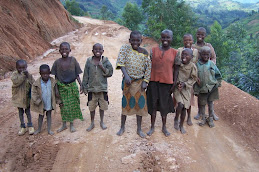
OK, its three months since I left Rwanda and I’ve had time to adjust to life back in the “real world”. Christmas and New Year have been and gone; I’ve seen most of the relatives; I’ve even met up with a group of past and continuing volunteers.
Here in England we’ve had the coldest winter for years; I managed to arrive at Gatwick airport just as the bad weather started and it certainly made an abrupt transition to have to cast aside sandals and short-sleeved shirts for thermal undies and many layers of clothes!
I’ve got myself a job, and been approached for another one only to have to turn it down. I’m working part time for our local museum in Bridport as “community engagement officer”. My role is to co-ordinate the rota of volunteers who man the museum during its opening season; to write press releases and generally extend the reach of the museum; to help find funding to enable us to stay open and remove admission fees for 2010. For the first time in 40 years I have left the world of education. I’m discovering a whole new world in which not only do I not have the long school holidays, but the holidays are to be my busiest work periods.
I’ve put on at least a stone in weight due to Teresa’s cooking; my belt has gone out at least one notch since Gitarama I’m back on my bike and rediscovering my cycling muscles. (The Bridport hills seem to have got steeper and longer during my absence).
I’ve already done around ten talks and slideshows to various groups about my time as a VSO to audiences ranging from Womens Institutes to schools to our Town Twinning association and church groups. I have bookings to do talks as far into the future as September, and there will be more to come.
In my final blog from Africa I promised to write a summing up entry, and I’ve rightly been taken to task for dawdling over the job. OK, I apologise for the delay, and here comes the collected wisdom(?) of Brucey Baby
What did I learn, what did I achieve and was it all worth the effort?
Firstly, my experience in Africa has affected me profoundly. It has enormously deepened my understanding of poverty, under development, and the problems faced by countries like Rwanda. It has taken me way beyond the stereotypes of helpless, lethargic Africans as passive recipients of aid. It has shown me that Rwanda truly is “a country in a hurry”, with some educated, energetic and visionary people. In particular it has taught me that just as there is no single cause of underdevelopment, so there is no single (or simple) solution. It’s like trying to untangle a ball of knotted string. You cannot, even with all the goodwill and best intentions in the world, try to resolve Rwanda’s problems by focusing on any one aspect of life such as education.
To give you an example – you try to persuade children to complete their primary education. But you soon discover the reason why children don’t finish to the end of year 6 is because they have to leave school to work and earn money. Or there are family members who are ill and need nursing. Thus you can’t solve an education issue without doing something about agriculture and food security, or about creating local employment in the non-agricultural sector, or about public health. This is very demoralising. No single person has the time or resources to intervene in all the areas of education, health and job creation, and because you can’t tackle all of these you tend to feel helpless. What’s the point…… You eventually learn that you have to plug on with those things you can influence, hoping that you are creating the conditions for fast progress when some other agency addresses those areas you can’t reach.
And your fumbling, well-intentioned efforts to help can produce unfortunate side effects. I channelled money from my local community in Dorset to install or repair water tanks in schools. All well and good, and nobody could possibly object to providing clean water as a worthwhile project. But I now discover that the fact that the schools have water on hand, while the villages themselves often do not, is a cause of friction. The schools are usually reluctant to share their water with the villages because there isn’t enough for everyone, and the villagers are resentful of the school having water while they themselves have to walk long distances to find polluted water from streams or springs. So my altruistic attempts to solve one problem have inadvertently led to another. So you have to sit back and take stock. Do you abandon the school projects because you can’t afford something which embraces the local community as well? Answer - no; you do what you can in the schools and let the Rwandans sort out the other issues.
A second thought on my experience is that it has made me into an enthusiastic “ambassador” for the country. Most people in my little corner of England have absolutely no idea what Rwanda is like. The opportunity to speak to various groups and show lots of good quality photos is going down a storm. For me, I’m re-living my time in Africa. I’m able to raise awareness and dispel many myths. People are interested; they ask penetrating questions; they are desperate to get beyond the image of Africa as a place of disasters and emergencies and learn about what it’s like to live there. Its empowering to be able to tell them about the good things as well as all the problems.
One question I am always asked is “Would you like to go back?”, to which the answer is always “Yes, definitely, but in a couple of years’ time and for a short placement”. I would be intrigued to go back to Muhanga district and see just how much and how fast things have changed, especially in the countryside.
People are still amazingly generous, and even though I have finished my stint at Gitarama, I have sent £1000 out to Ken, my replacement, for him to continue getting water into schools. And money is still coming in.
A third thought is that I have made an entire new set of friends as a result of my experience. When I applied to do VSO I imagined that the majority of volunteers would be men, and recently retired like me. It came as quite a shock to discover that most volunteers were young women in their twenties. (Not that I’m complaining!). I never cease to be surprised at just how international the volunteer community is; how knowledgeable so many volunteers are on such an enormous range of topics, and just how lovely they are as people. The friendliness and energy and enterprise of other volunteers becomes infectious, and it gets you through the difficult times.
What did I achieve in two years as a volunteer? Did I “make a difference”, as I hoped? I had too many schools to be able to make a difference in them, though I did have a lot of influence in those I managed to get to. My input was mainly to give new ideas – of teaching techniques, of ways to timetable, for example. I shared good practise between schools. I acted as advocate for schools suffering intolerable problems with buildings (Bikombe) or staffing (Ruli, Buramba, N). I praised whatever I found was good.
Some of our ideas do seem to have been taken up. There are classrooms with wall posters drawn on old rice sacks which make cheap alternatives for expensive western wall charts. Schools are using the action songs we taught them, albeit often to different tunes. Some schools have taken on board the idea of making learning active, so children are getting up and moving about instead of always being sat passively in the classroom. Some teachers are beginning to feel free to use their own initiative to very how they teach; to experiment and not feel crushed or humiliated if the experiment fails; to be more imaginative.
One of my more useful roles was to act as a conduit to enable schools to vent their frustrations over buildings, late payment of wages, lack of resources and the like, to the District office. Country schools feel abandoned; the difficulties of transport mean they aren’t visited for years at a time, and they feel that nobody in the District cares about them. To have a westerner visit them, blow a fuse at the state of the place and promise to take it up with the Director of education next morning made them feel that someone was listening to them; someone was on their side.
Am I leaving behind something which is sustainable? Sadly, no. VSO aims that placements should create sustainability so that after a few years international volunteers are no longer needed in the post. But what I found was that I was doing things precisely because there was nobody else to do them. The entire education, youth service, sport and culture for 100,000 people in an area the size of Dorset was being run by three full time people with one part time secretary. These people were competent and effective, but the job was just too much for them to do properly. I can’t see the need for a volunteer diminishing in the foreseeable future unless the Rwandan authorities increase staffing levels in the District offices. The trend is the other way – to increase workloads on those people already employed.
I like to think that the education service in Muhanga is better organised and runs more smoothly as a result of my efforts, and my main success was at the level of the District Office. In terms of my work with statistics I have changed the way things are run. Information is accurate and readily accessible, and planning and policies are much more school friendly.
In terms of physical legacy, my main achievement is the water tanks. Three complete cisterns. Replacements or repairs to five others. £10,000 of aid into eight schools, benefiting well over 8000 children and their teachers. The lifespan of the tanks is 20-30 years; the cost per pupil per year is about 6p.
Some achievements are less tangible. The people I worked with, without exception, found it comforting to think that people in the developed world were interested in them and concerned enough to want to help them. I think there’s a deep sense of abandonment in Rwanda originating in the unfortunate way they were left to their own devices during the Genocide of 1994. The outside world either didn’t intervene, or, as in the case of the French, intervened disastrously. To have westerners living among them, working with them, sharing their everyday hardships and in every way identifying with them was enormously appreciated.
Was it all worth the effort? – Yes, definitely. I was very lucky in my placement, but the majority of VSO colleagues thrived, and a large proportion extended their contracts.
I think a good placement is like a chair. It needs four legs to be effective. These legs are:
• A secure and viable place to live
• A sense that there is a real job for you to do
• A local boss who is supportive, gives you room to manoeuvre and values you
• Friends and colleagues to interact with.
If any one of these “legs” is weak, the placement becomes like a three-legged chair: it is possible but not very effective. If two or more of the legs are weak the placement is unviable, like a two-legged chair.
If you are thinking about volunteering, my advice would be definitely to go or it. You will certainly be put well outside your comfort zone, but you won’t be put in real danger. You will certainly suffer from discomforts, bugs, ailments and the like, but not such as to put your health and wellbeing at serious risk. There will be boring “what am I doing wasting my time here?” days, but they will be outweighed by the highs you get when everything comes together. You will make a lot of new friends. You will do things you never imagined you could. You’ll learn a lot about yourself.
And the rest of the world, when you return back home, will appear in a very different perspective.
So take the plunge and volunteer. I’m sure you won’t regret it!
Tuesday, 9 March 2010
Rwanda - the final reckoning

Thursday, 3 December 2009
Saying goodbye is so hard
December 1st
Today is my last full day in Gitarama. This will also be the last daily entry on the blog, although I’ll try to summarise two years of a life changing experience when I get home.
The rainy season seems to be ending; we haven’t had a heavy downpour from some time. This means the weather is absolutely idyllic. I wrote a couple of days ago about how clear and fresh and sharp the air was; well today is even more so. Gitarama has a fabulous climate and these days during the transition period from wet to dry are simply the best. No Garden of Eden could ask for better temperatures, sunlight, and general loveliness of nature around it.
Mind you, you’ve got to look over the choking traffic fumes, the throngs of people hanging around waiting for anything to happen, or trudging to and from the market. You’ve got to close your ears to the constant din from many sound systems, all tuned into different radio stations, all turned up way beyond distortion level, and all broadcasting different types of music from Tammy Wynette to Congolese dance. You’ve got to walk quickly past the free evangelical church, a couple of rooms above a parade of shops, where there’s always a service going on at half past six in the mornings and where the preacher is bellowing at his flock like a headmaster trying to cow a bunch of naughty schoolchildren. You’ve got to zip past the market with its revolting smells of fermenting cassava and the riper, sweeter smell of decomposing unsold fruit and over-ripe fish.
This is Africa – colourful, noisy, frenetic and indolent at the same time, hopeless and ambitious at the same time, grasping and giving. I love it here.
I have to stay at home till half past seven because Dieudonnée, the head at Rutarabana, stopped me in the street yesterday and demanded I give him a leaving present for his school. Sheer cheek, but it’s very Rwandan and if I were in his position I would do the same. I decide I can afford to give him a very small sum to buy dictionaries for his senior classes, and have the money all set aside in an envelope for him. But he never shows up. That’s a nuisance because it means I’ve missed the golden time of 7 – 7.30 in the office when it’s easy to collar people and get things done. I’m miffed at his no show, and decide I’m not going to pursue him. If he really wants this money then it’ll be his job to come and find me. I’m the one with the deadline.
In the town centre it looks as if a vehicle has lost its oils sump or fuel tank; there’s oil or diesel spread right across the road and the stench is overpowering. It’s nobody’s job to clear up the mess, so it will just remain forever there, a stain on the heart of Gitarama.
At the office there’s no sign of Claude. This is the day when I’m supposed to be saying all my formal farewells, but Claudine isn’t there either, and Valérian is in and out all the time, so there’s not a lot to do. Soraya and I stay for two hours. Claude’s been and gone, and left his modem behind so I’m able to do some internetting. Both power points in my office have stopped working, so I sit at Claude’s desk and use his wall socket, much to everyone’s amusement. (But hot desking is common here, and Claude’s computer is always being shared around the other District Office people. At one point someone comes in and thinks my computer is Claude’s and demands to use it in ten minutes’ time).
There’s no post for us, either, and when Karen comes in from Shyogwe the three of us go to the little café across the road for a fanta. Meanwhile I’m waiting to collect some money from Marin from last weekend; eventually she sends a driver specifically to find me and give it to me.
By this point I’m getting worried that I still haven’t started putting things in my suitcase, and I’m also worried about how heavy it’s going to be. So I abandon the office and leave word that I’ll come in first thing tomorrow before I set off for Kigali. Charlotte has come up trumps and is going to take me to Kigali on her way back from Shyogwe; I’m mightily relieved that I haven’t got to juggle a suitcase and two rucksacks on the buses, especially those in Kigali town.
Back at the flat I find packing relatively straightforward. I’m leaving behind almost all my clothes except those I’ll wear for the journey; I’m leaving all my toiletries and medicine, and, of course, my motor cycle helmet. That means that even with souvenirs there’s no problem of space in the luggage; it becomes a question of weight. Tom arrives with a spring balance and when we weigh all my stuff I’m below the flight limit so all’s well.
Épi texts to say she’s meeting me in Kigali tonight; that’s perfect because we can swap photos and music.
I have a packet of cake mix from my sister, and the plan is to bake it up into little buns and take some to Janine to make her feel better. But for some reason the only adaptor plug I have left out and available decides not to work, so I can’t get our oven to operate. No matter, I’ll bequeath the cake mix to Tom and he can sort it out at the weekend.
For my final lunch in Gitarama I decide to go to Nectar and have omelette special; it’s one of my favourite delights of Rwandan cuisine. Then I get a moto round to Janine’s house. At last she is back home from hospital, and starting to make progress. She is out of bed, and has been walking around in the house and garden. But sitting up for any period of time is painful, and after twenty minutes I can tell she’s had enough. The room is full of people, her brothers and their friends are watching a DVD on a laptop. It’s an odd feeling – you’re having a private conversation in a room full of people because everyone except Janine and myself is glued to the Kinyarwanda soundtrack on the DVD.
Saying goodbye is always hard, but in Janine’s case it is particularly difficult. She’s such a lovely girl, and has been so unlucky. Things have really knocked the stuffing out of her. But she has Tom, Christi and all the FHI volunteers looking after her, and a supportive fiancé and family, so she’s not cut adrift. She is signed off work for at least three weeks, but Tom’s inviting her to drop in at the FHI office now and then, unofficially, to keep up to date with what’s happening rather than to do actual work.
Back to the flat. My bedroom cupboards are bare; the walls are bleak except where we’ve agreed I’ll leave my Dorset calendar pictures and clippings from newspapers as decorations. It doesn’t feel like my space any more.
On one of the chairs there’s a big pile of clothes to go to the FHI office for the artisans to help themselves when they bring in their offerings next week. I really brought far too many clothes, and definitely far too much medicine. But as for the medicine, when you come to Rwanda as a VSO you have no clear idea what your living conditions are going to be like, and had I been way up in a remote place or more unlucky with my health, then I would have possibly needed everything that came out with me. In general we always come to Africa as if we’re on an expedition to Antarctica. The reality is that almost everything you need is available here, but it might take you a year to find out just how to get things. And clothes here are ridiculously cheap, and after a few months all the men get African shirts made up and so on, so there isn’t a need to bring more than a week’s worth of clothes!
In the evening Tom and I go up to Green Garden for brochettes and ibirayi. Even with two orders of these, they still manage to screw up the quantities, but we just laugh. We’re joined by Nathan, Marin, April and Helen and stay for a couple of hours. Marin has her bodyguard with her; he also gets brochettes and stays in the shadows a discreet distance from us. It’s a hell of a situation for her; let’s hope the catch the man who is threatening her and lock him away soon.
Back to the flat and to bed. My last night in Gitarama and there’s at least a couple of mosquitoes in the room. I really can’t get my head round this. Joe Walk’s right by the lake, at a lower altitude, and yet he has almost no trouble with mozzies at all. But we always have them in the flat – not swarms but enough to make it uncomfortable to sleep without a net – and Moira has them as well just up the road in Kavumu. I’m looking forward to being able to sleep without a net in England. The news from home is that the rain and floods seem to have finished for a while, but when I land at Gatwick it will be bitterly cold with snow across the whole of the north of England. So it looks as though there’ll be no mistaking where I am when I land!.
Finally, as a full moon rises across the town and Africa glistens under its light, a word of thanks to all those of you who have been reading the blog. According to my tracker there have been some 15000 visits to the site, from around 30 different countries. If it has given you some insight into what Rwanda is really like; if it has shown you what it means to be a volunteer in one of the poorest countries in the world, then it has served its purpose. I started it for my family and friends back in England as an alternative to writing endless letters, it then spread to prospective volunteers about to come to Rwanda.
I came to Rwanda absolutely petrified that I wouldn’t be able to cope with the heat, the crowds, the language, the work, the insects and diseases – my biggest fear was that I would collapse and be sent home in ignominy as a failed volunteer. Two years later I find that Africa has become home; the strangeness of everything has become normality. I’m operating well within my comfort zone, and I find I’m apprehensive about returning to an England where there is economic recession, political lethargy and general malaise. I feel out of step with the way of thinking in the west and I’m going to find the materialism difficult to adjust to. For all long term volunteers the “re-entry” period is not easy; perhaps I’m lucky in that I’ve got all the Christmas business to distract me.
Would I volunteer with VSO again – YES! I’ve been lucky, but I’ve had a tremendous time.
Out in the sticks - pictures fom Rutarabana village

One of my absolute favourite shots of Rwanda. This is the kind of footpath you follow if you step off the earth roads to take shortcuts. Deep under the banana and mango trees it's difficult to see where you're going!

It doesn't take long to leave the town behind, leave the earth roads, and get deep into solid greenery. This is a long shot across a sea of banana plantations and crop fields towards my part of Gitarama (Gahogo). Double click the image to get it enlarged.

Another view looking towards Gitarama in the distance
Wednesday, 2 December 2009
Fighting the same old battles
It's World Aids Day. This is an extract from Wednesday's "New Times" and applies to my own district of Muhanga, showing that we've got a long way to go to change people's attitudes.
Religion hampering condom use
MUHANGA – Religious teachings in Muhanga district are causing residents to shun condom use and thus involve in risky sexual behaviours, Joel Serucaca, the district health coordinator said yesterday.
“We need combined efforts in educating residents on the dangers of HIV/Aids because it has become evident that few people are using condoms due to religious conviction.
This has impacted on the HIV prevalence levels,” Serucaca said during the commemoration of the World AIDS Day.
Residents in Meru trading centre, in Muhanga sector noted that condoms are easily accessible, however, they said, recent increase in condom prices has subsequently affected their use.
“The price of ‘Prudence’ condom has increased from Rwf50 to 100, while the ‘Life-Guard’ condoms have increased from Rwf200 to 500 in the past weeks. The condoms are expensive and we cannot afford it,” one cyclist said.
Other youths who spoke to the New Times said they are afraid of buying condoms for fear of being ‘regarded people with multiple sexual partners.’
Over 10,000 condoms were distributed in Kibangu sector during the world Aids Day commemoration, according to Serucaca. The district has planned to distribute over 100,000 condoms in the next three months during promotion campaigns.
The HIV prevalence rates in Muhanga district are estimated at 3.9% according to 2007 report.
Tuesday, 1 December 2009
Fresh strawberries in November
November 30th
Claude has asked Soraya and I to go into the office for a meeting, but when we arrive we find the meeting doesn’t take place. Also the internet is down. At least Claude seems to have shaken off his malaria and is back in the saddle. The problem is that he’s now besieged with people all morning, and there’s the big meeting of everyone who works in the akarere after about eight o’clock. So Soraya and I are left to our own devices.
At eight o’clock I take a moto out to Mushubati and pay the remaining money into Nyarusange’s school so that they can complete their water tank. That’s the absolute last slice of water money – three complete systems, and about five repairs or improvements in other schools. 8500 pupils with access to clean water.
It is turning out to be another of the beautiful mornings at the end of the rainy seasons, the visibility is pin sharp. Muhabura volcano is clear and well defined from my lounge window, and the mountains around Gitarama look inviting. If I had my own moto I’d be sorely tempted to cut work today and go off into the hills for a good walk.
I have to wait a while at the office for some money I’m owed, but then I take off back to the flat and pack a bag with clothes that I won’t be using any more. I’m going out to Rutarabana to say goodbye to Delphine and her family (in Rwanda goodbyes are very formal occasions), and I might as well give them my unwanted clothes. The alternative would be to give the clothes to a market trader to sell, or leave them in Tom’s FHI office for his suppliers to pick through. But I decide if I’m going out to Rutarabana to say goodbye to her family I might as well give them my cast offs and save time. With eight children there’s no question but that they need them, and even though I’m twice the size of some of them they’ll either cut and adapt them or sell them. I’m welcomed like a hero and fed.
Delphine repays me the loan she took out from me to buy beans a couple of months ago. I lent her 100,000 francs and she bought a huge consignment of beans at the height of the season when prices were low. She has since sold them to secondary schools with boarding accommodation in Ruhango District to feed to their pupils and has made a return of 30% on her outlay. She’s what we call “une bonne commercante” – she’s got a head for money. Clarisse, the next youngest sister, has just finished secondary school and has applied to join the police. She’ll be fed, given a uniform, accommodation and generally well looked after if they accept her. (It’s very competitive; at least 74 people are applying for around 12 places). The oldest son is in his final year at ETEKA technical school and will also be looking for a job soon.
In the afternoon we take lots of photos, and I’ll print some off when I get home and send them to the family via Moira (Delphine is Moira’s domestique). I notice that getting photos printed here is hideously expensive, so photos become a luxury. Everyone has a small album which is trotted out whenever there are visitors. Even at Claude’s house, all the pictures of Keza which I printed off last time I went home are up on the walls in places of honour; it’s as if the only pictures he has are the ones Soraya and I have taken of her.
As we walk back home we pass the family’s patch of strawberry plants; they are just coming into fruit again (in Rwanda most growing things have three or even four seasons a year), and we stop to sample the crop. Just imagine – fresh strawberries on the last day in November. Britain is bracing itself for frosts, snow and goodness knows what else; I’m sauntering around in shirtsleeves with my hands stained red from strawberries!
In the evening I go round to see Helen and April and we swap pictures from the weekend, as well as stuffing ourselves with honey pancakes. Then April tests my hearing (she’s an audiologist and for all I know may be the only one working in schools in the whole of Rwanda). I have significant high end hearing less, which is apparently normal for someone my age. It explains why I’ve been finding it difficult to follow conversations in noisy bars where the TV or sound system is at full blast, or where there are bare concrete walls and very echoey sound. It’s tough getting old and decrepit!
Teresa rings and we talk through the final lists of what to bring and so on. I’m running out of time fast, and really need to start throwing things into the suitcase tomorrow.
Mugged by a monkey at Kibuye
November 27th-29th
Into the office to tidy up a few odds and ends. It’s a glorious morning; bright and sunny. The mist is rising as usual from the valleys. The sky is clear blue, and all the buildings in Gitarama are glowing in the low angle sun (this is half past six in the morning, folks). Just when I think it’ll be a quiet morning I find that Claude is not in; his malaria is getting him down. So Valérian is in charge. I tell Valérian that I want to be able to say a few words to all the heads at the big meeting, and he agrees. Claude also wants me to summarise what I’ve found over the past two years and do a report to all the heads. This is not as easy as it sounds. There’s so much variation between schools that whatever I say, either in praise or criticism, won’t apply universally. And, of course, I’ve only been dealing with the primary and new tronc commun schools.
I quickly note down some things on a power point, but there will be no digital projector at the meeting so it’ll be all wind and bluster when I speak. As it happens, Valérian puts me on almost the first item on the agenda, so I’m able to do all my bits. It seems to go down OK; they all agree with me about the things I praise; there’s some toe-shuffling moments when I tell them what I think should be the priorities for the next year or two, but that’s understandable. If three quarters of them haven’t finished their strategic plans after a year in office they’ve got every reason to feel uncomfortable. After all, none of these heads teach; they don’t have anything like the workload of an English primary or secondary head, and there’s really no excuse for not getting some of these key parts of their jobs done. I know that this probably sounds presumptuous on my part, but then it’s exactly what Claude has been asking me to do, and what some of these heads have been asking for is an outsider’s take on how well they’re doing. No doubt most will ignore what I say, but if even a few take it all on board their schools will be improved and eventually their jobs as managers will be made more effective.
I say my formal thanks to all the heads, and get a very fulsome response from both Valérian on Claude’s behalf, and from Emmanuel on behalf of the heads. They’re seem really serious when they’re asking me to come back at some time in the future.
I nip back home quickly for some lunch, then pack up ready for the weekend. I’m taking Delphine with me to the Kibuye weekend, and we end up sharing a small matata all the way. She’s never been to Kibuye and in going as part of a big group it will all be very proper; it’s not as if we’re running off to spend a weekend together. The big coaster bus is already fully booked, and until the last minute I haven’t been sure whether Delphine’s parents were going to give her permission to go. As things turn out she has one of the best weekends of her life. This girl has never been across the Nyaborongo river before, and that’s only 20km from Gitarama. In the course of twenty four hours she discovers the western province of her country, discovers Kibuye town, sees Lake Kivu for the first time, has the first boat trip of her life, visits an island in the lake, gets her first experience of swimming in deep water, eats western food like pizza for the first time ever, and generally gets accepted by a bunch of sixteen muzungus. That’s all heady stuff for a young Rwandan girl, and she’ll be telling the tale to her family and friends for weeks to come! Rwanda is a small country, and it turns out that one of the staff at Home St Jean, where we stay, is a former classmate from the secondary school in Karama. So she’s even got someone to talk to in Kinyarwanda while she’s there.
The weekend is lovely and gets better as time goes on, except for Friday’s weather. Friday turns cold and grey by the afternoon, and even down on the lakeside it is decidedly chilly in the evenings. The wait for food at Home St Jean is interminable, but the rooms are cheap and the view and general ambiance make up for the delays (and we can eat elsewhere tomorrow).
On Saturday we decide to hire a boat and all go across to Peace Island. We are decidedly “out of season” here at Kibuye at the moment, which means we can hire a boat very cheaply. Joe and Nathan are a bit late getting down to the boat, and by the time they get to the jetty our boatman has already left without them. This is because he’s trying to earn more money by piggybacking us onto a group of local government official who are visiting one of the tiny inhabited islands to do a census. (I suspect they work for Rwanda Revenue, the income tax service of the government). We drop them off on a tiny shore, like castaways, with the islanders cautiously coming down to the water’s edge to see who is visiting their little patch. The islands in the lake are the tops of submerged hills. There’s virtually no flat land at all, just steeply sloping mounds of rock which rise straight out of deep water. They’re only fit for goats, and it’s surprising to see a few cows in places. There seems precious little cultivation of crops and I really can’t work out how they scrape together enough to eat. The vegetation looks very dry and scrubby, surprisingly so because it is within feet of a huge lake and in one of the wettest parts of the country. Houses are on little ledges hacked out of the hillsides. I don’t think any of the islands have the slightest trace of running water from streams; they’re far too small. You just use the lake for your water supply; let’s hope they don’t use the same area as their toilets!
Having dropped off the officials we persuade the boat crew to go back to the jetty and pick up our two colleagues. So we get an extra long boat ride for the same money. The boat rocks in swell from a passing launch and Delphine grips the sides with white knuckles; she’s never realised that boats aren’t as stable as buses. The water is crystal clear and calm; in the lee of the dozens of little headlands there are patches of water like glass, which mirror the encircling islands perfectly. It’s turning out an idyllic day. We reach Amahoro (Peace) Island and disembark. Our boat is going to do other runs, but one of the crew is staying with us; when we’re ready to return he’ll phone his mate to come and collect us. I don’t want to be cast away like Robinson Crusoe just a few days before I’m due to fly home. It is getting very hot, so we strip off and swim. There’s a tiny ramshackle jetty on the island which sticks out just far enough to use as a diving platform. The water is clean but cold, and we only stay in for ten minutes. It doesn’t compare with Zanzibar, but then we’ve been spoiled by our fortnight in paradise there…. We do have little fish swimming around our feet, and cormorants are diving after them just a few score feet away from us. The views in every direction are breathtakingly beautiful; from time to time Karisimbi and Mikeno volcanoes shed their cloud cover and peep out at us in the distance. The far shore of Congo, and the edge of the rift valley, is just visible as a blue line against the sky. Every so often a dugout canoe paddles away in the distance. There’s no sound of engines, no planes, and above all no crowds of people. Peace indeed. By this time it is seriously hot in the sun, so we come out of the water and toast ourselves to get dry and work on our tans, but the wise ones among us are covering up after fifteen minutes or less. We’ve ordered food, but everything on the island is exorbitantly expensive and many of us opt not to eat until the evening.
While the food is arriving I go to explore the little island. It consists of two little hills, each about a quarter of a mile across, with a rocky beach joining them. It’s shaped like a figure “8”, and the swimming place is in the middle. On the far end there are ledges cut into the hillside for camping, and a path goes all round the shore line. From the furthest point the views out across the lake are breathtaking and it’s the only place I know where you can begin to visualise just how vast this lake really is.
But Amahoro Island is also home to a monkey. The beast is usually kept chained up, but unknown to any of us it has managed to untie the rope from the tree and is roaming the island. I encounter the monkey at almost the furthest point on the island, and for some reason it really goes for me. I haven’t done anything to provoke it; it just decides to launch a full-on attack at me. I’ve got nothing to protect myself and get a whole series of deep scratches on my back and arms trying to throw the thing off. It is amazingly agile; leaping into the little trees at this end of the island and launching itself down onto my neck. Fortunately I manage to stop it biting me. All I have to defend myself with are stones from the path. I’m trying to run backwards while defending myself; the ground is uneven and I fall backwards once which gives the monkey another chance to attack. Three times I have to fight it off. Where there is a clear space on the path there is a stalemate between us; I’m picking up rocks from the edges of the path and hurling them at the monkey to keep it at bay, but whenever we pass under a tree it leaps up and comes within striking distance. Eventually I get out of the tree cover and onto the rocky beach in the middle of the island; The monkey doesn’t dare attack me anymore because it has no trees for cover; I have tons of rocks all round me, and the rest of our group have seen something’s wrong and are beginning to gather. It’s been quite an experience. I’ve been prepared to find snakes, or scorpions or things like that in Rwanda but never to be attacked by a monkey.
I later discover that the animal also attacked Marion a few weeks ago, bit her, and that she needed extra anti-rabies jabs to make sure she was OK. The monkey never bit me (we examined all my wounds very carefully). I have several deep scratches but no bites. So far as I know it is only saliva which carries rabies, so even if the animal is infected it won’t have been able to pass rabies on to me. My tetanus jabs are up to date, and we swab the wounds thoroughly with antiseptic wipes, but I’ll see a doctor when I get home.
I have no idea why the monkey attacked, nor why it should choose me. I was not taunting it, or threatening it. I don’t think the monkey has a territory into which I was intruding – it usually lives next to the island owner’s house at the other end of the island. Either it has been mistreated in the past, possibly by a muzungu, and is taking its revenge on any other muzungu it can reach, or, more frighteningly, there is something seriously wrong with it which is making it attack people.
We come back from the island to the mainland. The weather is changing fast – the skies are cloudy, there’s a lot of wind, the lake is no longer glassy but full of little waves which strop and splash over the sides of the boat. We ask the driver to drop us at Béthanie and walk back to Home St Jean to warm up. In the evening the intention is to do salsa dancing to Marin’s music, but by the time we’ve eaten we all feel overdone with sun, swimming, fresh air and general excitement, so we settle for an early night.
Kibuye is a magic place and remains my favourite spot for a relaxing weekend. To anyone reading this who is a volunteer about to come to Rwanda – don’t let the episode with the monkey put you off. The beast is usually tied up and harmless if you stay out of range. But if you do go to the island and it is loose, then stay with the rest of your crown and beware!
Final postcards from Kibuye

All aboard for Peace Island

April and Helen.

Soaking up the sun on Peace Island

Catherina and Tom at Hotel Bethanie. Catherina is one of two very young German girls who have been placed to work in our Gitarama special school with handicapped children.