September 14th
Into the office early with a massive hit list of things to do. By five past seven I’ve printed off eight inspection reports and plonked them down on Claude’s table for him to read and be impressed.
What a pity he isn’t in today. And it means most of the things on my shopping list of jobs to do can’t be done because I need to get information or decisions from him. What’s the disposition of all the schools in Kiyumba? What’s he going to do to tell the Nyabinoni schools they mustn’t beat primary children? What’s he going to say to the local head teacher to stop her school preventing pupils attending until they’ve made a voluntary donation towards a building project? When can he get me an official government pad of lesson observation sheets….?
The Kibingo census form has arrived under my door, so I’m only missing one more now.
I spend no less than two hours blogging and dealing with emails (Claude has been thoughtful enough to leave the modem in his drawer), and then I ring Cyeza and arrange to go and watch History and Geography lessons there. Getting to Cyeza is so easy now – I know the price and route and everything else. I remember how distant it seemed last year, and how much I had to screw up courage to get on a bike on my own (without Cathie) and go there, and I laugh at myself. Why am I such a timid bunny at times?
Soraya comes into the office and between us we start planning for a Kiyumba week next week. We can’t get very far with this because we don’t yet know where all the schools are, and everything is going to depend on the rains, but at least we’ve pencilled in the dates and some possible schools. I’ll ring the priests at Kanyanza on Friday evening.
At Cyeza I dismiss the moto because I don’t know how long I’m going to be there. As it happens I watch two lessons with an hour’s break in the middle when I find a tree and sit under it to relax in the middle of the countryside and fend off all the curious people who want to come and stare at a muzungu who is hanging around doing nothing. I wonder if they will come and ask me for money; the kids are just brazen but the adults try to be more subtle. Nothing doing, guys, I’m afraid, and you can’t charge a muzungu for sitting under a roadside tree!
An extraordinary thing happens. A wave of pupils is dismissed from lessons and charges off down the dirt road towards the river and the surrounding houses. This seems odd; morning school finishes at 1215 and this is only about 11 o’clock. Then, around twenty minutes later and just as I’m going to watch my second lesson, these pupils all come back to the school. And every single one of them is carrying stones on their heads. Great big slabs for the older children; smaller stones for the weenies. In the meantime they’ve all made little carrying rings of banana leaf to protect their heads from the weight of the rocks. They silently process past the classroom window and you can hear the thumps as they add their rocks to the pile at the building site where new classrooms are going up. Nothing quite sums up the “do it yourself or do without” situation of the schools here. The pupils are literally going out to find stones to help build their new classrooms, and their parents are giving their time free each morning to make mud bricks, dig foundations, make cement and lay the stones and bricks to construct classrooms.
It’s the same teacher doing history and geography. She knows her stuff but has no resources and therefore it is difficult for her to make her lesson come to life. The class is sullen and unhelpful and there’s a constant buzz of talking in the back of the room even with me sitting there. In history she is teaching about the cult of Ryangombe. Ryangombe is a central figure in Rwandan mythology; the popular and successful hunter and leader who was eventually killed by a wild buffalo and now resides on the top of Karisimbi mountain. The pupils find it all a bit boring and irrelevant. In the debrief I suggest that next time she starts with the relevance of Ryangombe today. There are still men who like to model themselves on the warrior hero, and various rituals and observances remain. That would hook the pupils, especially some of the boys, and would make it easier for her to trace back to the roots of the legend.
After I’ve debriefed I start walking back towards Gitarama. There’s a fair amount of traffic on the earth road and I trust that sooner or later I’ll find a lift. It’s the heat of the day (I seem to make a habit of doing long walks at the wrong time of day), but after walking about half the entire distance I’m very relieved to find a moto without a passenger and negotiate a fair price back to the office.
Last time I came to Cyeza I got charged a lot for “waiting time”. Doing things this way has cost me 2500 instead of 4000, and a lot of exercise to reduce the flab I’ve put on up in Nyabinoni last week.
In the afternoon I’m working really hard on writing reports, trying to phone schools to arrange visits, and trying to do last week’s blog postings. I find that when I’ve been away on one of these trips up country every day turns out to be an adventure and trying to remember all of it for posterity means I’m writing long essays! But even reading what I’ve put about the Rongi trip ten days ago reminds me of incidents I’d already forgotten, and I find all this writing very therapeutic. I must be taking out all my frustrations on you people who are my readers! Sorry, folks! Rwanda is beautiful and I wouldn’t change my placement for anything. It’s one of the best things I’ve ever done in my life. But, yes, it does get tedious and annoying at times.
Some schools for the rest of the week are easy to contact; others don’t answer their phones. I have to keep reminding myself that we’re in hill country and it’s quite possible that the teachers are never able to use their phones while they’re at work. Only three out of six schools make positive contact. Never mind, they’ll all be at a big meeting in Gitarama tomorrow so I’ll be able to nobble them and finalise my travel plans.
I cook up a huge vegetable stew so that there’s enough left for tomorrow, and by then I’m pooped and totally ready for bed.
Best thing about today – going out to Cyeza; it’s my 90th formal visit to a school. Ten more to go to my self-imposed target!
Tuesday, 29 September 2009
Teaching about Ryangombe without resources

I'm getting preoccupied with water
Saturday and Sunday, September 12th and 13th
This is going to be a quiet weekend. Most of the girls are off to the north to climb Karisimbi volcano. My feet aren’t up to a two day climb, and in any case I’m too tired from the week’s visits. Soraya wants time to recover, too, so I’m resigned to being on my own until Sunday evening.
I don’t get much sleep during the night. The night club down the road is thudding out a heavy bass line until five in the morning, at which point the guard gets up and his dogs start yapping. After the infinite quiet of Nyabinoni, with nothing but the distant coughing of cows and the early morning buzz of bees around flowering eucalyptus trees, Gitarama sounds so noisy. I wish I were back up in the wilds!
I get up early and I’m fazed by the water crisis. There’s no water even in the downstairs tap. The SORAS houseboy tells me there may be no water for four weeks. That means I have about three quarters of a jerry can of water and nothing else at all. (Except for my filter, which happily I filled right up before I left to go on my travels this week). It means that I’m going to have to wander from house to house with a bucket to get water until the rains come and the system gets back to “normal”.
I start to minimise water. No washing – use wetwipes. No flushing the loo – shut the lid and let everything stink in there with the window wide open. Washing up in an inch of water and never mind if the pans aren’t 100% clean; then throw the filthy water down the toilet. No washing hands before I eat – use the disinfectant gel that’s been sitting on my bedside table for months. No beer – it’s dehydrating. Sips of water rather than gulps. Put all this together and my jerry can should at least last me all the weekend and possibly Monday too. That should give me time to find a way round the problem.
I get started on writing up my inspection visits. Six reports, each of around six sides. It’s a lot of writing. By late morning I’m on my fourth. Then two things happen in quick succession. The SORAS houseboy has found somewhere nearby which has water. He’s filled up all his jerry cans and asks me if I want him to get water for me. Do I want…… this guy’s a saint! He fills a jerry can and two buckets for me and my immediate problems are over. I can even have a wash in a kettleful of warm water and perhaps the luxury of a shave, too. Mustn’t frighten the locals too much with my ghastly grey stubble!
Its good timing that I’ve got myself civilised, because within the hour I’m hosting Mike and family en route to camp in Nyungwe Forest. There’s rarely a day when we don’t have some of the other volunteers calling round, but the twins are definitely the youngest visitors we’ve ever had here!
After they’ve set off south I finish my fourth report and start making lunch. I’m tired with eating other people’s food and want to make something of my own. I’m afraid I’m not very imaginative in these situations and it ends up as my usual vegetable soup, this time with sweet potatoes instead of “Irish” spuds because the latter are still an exorbitant 150 francs a kilo (15p) in the market. Sweet potatoes are only 100 francs, so how sad am I that I’m saving 5p…..?
By the end of the afternoon I’ve nearly finished a fifth report, but I’m getting seriously jaded and need a change. In the evening I cook up an experimental concoction with salami sausage in runny peanut sauce, French beans and carrots with shell pasta. It’s wholesome enough but it wouldn’t win any prizes. The guard, who hasn’t been fed for over a week, can hardly believe his eyes when I bring him a plate of food.
I decide to watch a video for the evening, and I manage to get one of Piet’s films (Vanilla Sky) to run using my VLC software. It’s a bit clunky – the film seems to be divided up into 20 minute sections and I keep having to find and load the next segment, but it passes the evening. When I’ve seen it I can delete it and free up more space on my hardware. I also spend half an hour tidying up music files; I discover that some CDs are on my computer twice and I need the space for all the photos I keep taking….
During the evening it starts to rain properly. There has been a gusty wind blowing for most of the afternoon, and It’s been evident the rains are upon us. I’ve spent an hour making lists of the schools I think I can visit during the next week or two, but I think I’m going to be overtaken by the weather sooner than I thought. I curse myself for not getting more done as soon as I returned from England in August, but there you are – hindsight is a wonderful thing!
Sunday morning dawns cool and windy. More rain to come. At least I’ve been able to sleep without night music or yappy dogs.
Up early and get the final inspection report done. That’s a load off my mind. I decide to go to Momma’s for church because with all the girls up the mountain we’ll be short of muzungus at the service. I decide to practise my water minimising new life, so I mix a kettle of warm and kettle of cold water (that’s about 3 pints, not much at all), and use it to wash hair, shave and shower. Then it flushes the loo. Ha! I’m getting the hang of this economising lark! Just takes twice as long as usual, that’s all.
At Momma’s there’s only Meredith and Edison, the two Peace Corps volunteers, besides me. The service is more disorganised than usual; they’ve had a problem during the night with a young man taking an overdose of somebody else’s medication, and they’re not sure whether he’s going to pull through. All the adults are preoccupied; the orphans are unsettled and fidgety.
At the end of the service Arlene (Momma) asks me to sort out a problem with children at a local school. The school is demanding 2000 francs from each child for a building project. That’s all very well, and happens at most schools from time to time, but while Momma will try to find the money for each of her orphans, there are another 26 or so local children from desperately poor families who she supports in some way, from supplying shoes (pupils are not allowed to come to the town schools without shoes) to providing money for pens and notebooks. Apparently the school is demanding money from these children as well, and I understand that one child has been told she can’t come to school until she finds the money. Now that’s not on. It’s almost certainly breaking the law here, and certainly breaks the spirit of free education for the basic nine years which is the government’s current mantra. The head teacher is a colleague of mine, but if I find she knows this is what’s happening then she’s damned well going to have to change in a hurry or she won’t stay head teacher for long! Anyway it means that on Monday morning I’m going to have to throw my weight about in the office over this issue as well as the Nyabinoni practice of beating children for offences like lateness. I feel confident enough now to make a stir without worrying about cultural sensitivities…..
Back to the flat and dine on some more of yesterday’s soup (it made four batches), with left over pasta thrown in. On a whim I defrost some strawberry pulp that’s been lurking in the freezer for months (Delphine’s strawberries from the last rainy season). I decide to bring them to the boil just in case there are bugs left in them. Boiling pulped strawberries doesn’t do anything at all or the taste, I can tell you, but having kept them this long I’m not going to waste them.
With my official inspection reports done it’s time to start catching up on blogs, and that takes the whole of the afternoon. Outside the wind is whipping the leaves around; it’s like being in Dorset in our everlasting gales except that the temperature here is about 20 degrees warmer and the leaves being blown about are on banana trees!
At the Muzungu meal we are sixteen, with thirteen VSOs because we have Jane and Amalia with us en route for their placements in the south. Many of the girls have just come back from climbing Karisimbi volcano and are full of it – the slog, the useless mountain paths etc. Our group of people is so big it’s impossible to have conversations with everyone.
Back home and sort out some photos for the blog, and then bed. Another busy week beckons!
Back from Nyabinoni to "civilisation"
September 11th
Up and off to early mass again. We’ve had a text from Claude to say that after all, he isn’t going to be able to come and pick us up in a car, so we have to arrange our own transport back to Gitarama. We decide that it will be cheaper if we can get the two moto drivers from Kibangu to take us down to the tarmac road at Rugandabari, and then get a taxi bus back to town. The system works well in the end, but we’re desperately squashed in the matata. At one point there are five people in every row except ours, and six (plus a baby) in one of them. That’s approaching Tanzanian standards of overcrowding!
On the way back Soraya wants to stop at Shaki primary to pick up some rice sacks she left for them to copy when she did a training there on Wednesday. Now Michael has been to Shaki and warned me how awful the place was, but when I arrive there I’m really shocked. The staff are hard working, but the buildings are just appalling. The whole site is treeless, bleak, unloved. The school was built around forty years ago and seems to have had no maintenance ever since. The walls are crumbling for want of plaster; even the grounds look unloved and uncared for. We go into the staffroom to find the floor lined with washing up bowls of water, where the teachers are trying to wash the everlasting mud brick dust out of their white coats.
The road down to Rugendabari seems to take forever. It’s extremely hot and sultry, and by the time we reach the tarmac I’m getting seriously dehydrated. Fortunately we don’t have very long to wait for a bus, and we shelter from the sun under somebody’s porch.
Back in Gitarama, the place seems hellishly loud and uncouth and frantic after the pleasant quiet of Nyabinoni. If anybody tells us “bet you’re glad to be back”, we’ll say that “no, really, we both feel more at home up in the wilds”.
It’s been a tremendous week. Eight schools visited, every single one of them new ones. We feel we’ve well and truly earned our spurs as volunteers, and also that we’ve finally earned some acceptance by the head teachers because we’ve demonstrated we’re prepared to go to any part of the district to do our job
E P Jandari - my smallest state school

Jandari is my smallest state primary school, with just under a hundred pupils in two shifts, morning and afternoon. It has been started to relieve pressure on Rutongo school which is a big primary of 1080 pupils in the wilds of Kabacuzi. Jandari is run as an "ecole satellite" of Rutongo. This picture is looking up into the mountains towards Jandari from the edge of Rutongo's playground. Although we are well into the rainy season the morniungs are often sunny and extremely hot, as you can tell from this picture!
This is a good example of a common economy measure when building schools. The main structural pillars are made of fired brick, but the intervening parts of walls are of mud brick, and the whole structure is held together by mud cement and not portland cement. As a result the cement is gradually washed out from between the bricks by rain. The initial construction costs may be cheaper than building "properly", but ultimately it's a false economy because the structures need constant maintenance to keep them in good repair. If there's no money for maintenance, as is often the case, the buildings gradually weaken and can collapse.
Pupils on their way home from Rutongo school pose outside Jandari's one and only classroom. (The class at Jandari is year 1; while most pupils are seven or eight years old, a few are eleven or older and are only just starting school at that age).
Joseph strikes a pose by the moto. He'd just been mobbed by a bunch of girls from Rutongo primary on their way home from the morning shift, and was glad to be able to escape!
The afternoon shift lines up for the start of school. It's baking hot, but they can't go in until they are quiet and orderly. Many were late arriving. Once inside the room we have prayers for five minutes before lessons start.
Priscille, the school's one and only teacher, in action. She is helped by a teacher from Rutongo school to give her some admin time. The children standing at the back had arrived late for the afternoon shift and were being made to stand and wait along the back wall as a punishment. (This is standard practice). Priscille is very popular and when she and I did a double act on how to pronounce plurals properly, the entire class was riveted.
Half the class. There are no proper desks, just these benches. All the pupils are using slates to write on, but most lessons are rote learning.
Jandari's one classrooms is on the left. The room on the right is a parish store but will get pressed into service in january when the next intake arrives.
Looking down from Jandari towards Rutongo and the "Great North Road". This photo makes the hill look much less steep than it really is.
So you think you can handle a bike............

This is my driver, Joseph, easing his way over a temporary bridge on the (only) road to Kibyimba school. The old bridge had been washed away during the last rains. The gaps between the tree trunks are in places easily wide enough to swallow the bike's wheels. I chickened out and walked across, partly to help him balance the bike better but mainly because I didn't fancy being dumped many feet down into a rocky ravine. A broken leg out here could be fatal! If you're in a 4WD with fat tyres, though,this bridge is a doddle.
Friday, 25 September 2009
Bringing water to Muheta School
This is a photo essay of my visit to Muheta primary school last week. I discovered that Muheta needs money urgently for rehabilitating its water supply, and providing a shower room. One of my fellow VSOs has some money from her community in Ireland and we felt it was the ideal project for them to support.
 Just getting to Muheta is a challenge. It is a long way out from Gitarama town. You follow the valley of the Nyaborongo river and then climb and climb, up and up, winding in and out of little valleys and going back on yourself.
 You thread your way up and up into the Ndiza Mountains.
 Right now it's the end of the dry season and everything is brown and burnt up. We need rain.
 The only access road corkscrews its way up a mountainside. It it terminally muddy and slippery in the rains, and chokingly dusty in the dry season. In places there is a sheer drop off the side.
 Some rooms at the school are beautiful, with windows on both sides and little patches of flower garden outside. But these are only a few of the rooms.
 Other buildings in the school are the usual mud-brick ("semi-dur") design. These are old classrooms being converted into office + staffroom + store (on the right) and the school hopes to use the room on the left to set up a library. A library in a country district where houses have almost no books at all is a truly revolutionary idea. You see why I feel very fond of this particular school!
 OK so much for the buildings. Now let's meet Muheta's pupils.
 Muheta has almost no playgound, but it borders on this beautiful state woodland. Eucalyptus trees with grassy sward underneath and a real feeling of space. (Useless for ball games, though!). Up on the top of the hill is a big water tank fed from a spring which emerges even higher up the mountains. There's water in abundance even at the end of the long dry season.
 This is the first project. The tap has disappeared, and we are going to pay for a double tap attachment. There is lots of water in the tank on the hill but at prsent it can't be used by the school.
 I've posted pictures of a similar device in Ngoma District in eastern Rwanda, but this is an ingenious device using an old cooking oil can, string, and bits of wood to make a hand washing device. When you press on the pedal it tips the can and gives you a thing jet of water to rinse your hands. Alternative technology with a vengeance, and costs virtually nothing.
 Our second project centres on the toilets at Muheta.
 The latrines are very primitive. There is no running water to flush or wash hands after you use them. Muheta is a good school, though, and has water, soap and towels outside each classroom door. What we are going to do is convert one toilet cubicle into a wash/shower room, especially (but not exclusively) for the older girls. There is a general problem of girls dropping out in senior years, especially when they are not little girls any more but grown women, for lack of hygiene at the schools.
 Rural houses - 1. This is absolutely typical of the kind of dwelling most pupils in the countryside have as their home.
 Rural houses - 2. If you live in these there is no water nearby and you have to buy it from the water seller on his bicycle. Consequently water is at a premium and washing is only possible if there is water to spare.
 How many more twists and turns are over the horizon?
 Racing the muzungu down the road from the school. Despite the stones are the slope some pupils could outrun our moto - and a few of them were doing it barefoot!
 This picture doesn't really do justice to the slope angle, but some parts of the (only) road to Muheta are so steep and so rocky that even with a big moto I had to get off and walk and let Joseph inch his way down, jolt by jolt.
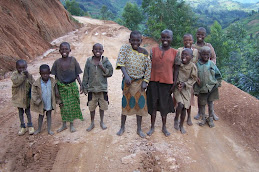
 My golly, don't they look suspicious! Just wait till they get running water at their school again!
Tuesday, 15 September 2009
More pictures from Kibingo
 Another shot of one of the log bridges we pass every few hundred yards. This is a "rolls royce" version which you can cross at speed.
 A series of pictures to show you this lovely modern school in its setting.


 The surrounding mountains really feel as if they're closing in on the eschool!

 Loos with views!

 Talking to one of the classes at the primary school.

 Here you can see the edge of the landslip, a mixture of earth and big boulders. This is precisely the bit that worries me because I think it will move again after the next heavy rain, and we do not want to lose these beautiful school buildings.

The two secondary teachers at Kibingo.
 Cassava carriers on the metal bridge.
 Let's end with two lovely moody pictures of the Nyaborongo valley

.