November 10th
Today is one of those busy days with too many interlocking details for my liking, especially in an African setting where delays and alterations are de rigeur.
Firstly I go to the bank and get solvent again. Then it’s up to the District Office to hand back the modem to Claude. He certainly won’t be happy if I forget and take it with me to Kigali. (I, however, will be very happy with a fast modem all to myself for the whole week).
In the middle of the morning Charlotte arrives from VSO office with Mike in tow and also Cameron. Cameron is the VSO Trustree (like a sort of school governor for VSO). He is director of VSO Canada and has come to East Africa for a big meeting in Nairobi. He has arrived a couple of days early for the main conference, and the idea is for him to spend a couple of days getting to know Rwanda, which is a country he’s never visited before. Soraya and I have been chosen as two experienced volunteers at work here to give him a flavour of what we do. Not to mention, of course, that we are conveniently only an hour or so out of Kigali so they can come and see us at work and still be comfortably back home in time for tea!
Cameron is a lovely person. I am expecting an elderly, ex-diplomat or civil servant, but Cameron is much younger than my mental image of him, and very down to earth. Easy to talk to, and with plenty of experience of the type of work that we do.
Firstly we spend some time with Claude so that Cameron can ask him about VSO fro the client’s point of view. We can’t stay long because Claude is off to Nyabikenke school to supervise the teachers there who are marking Tronc Commun exam papers.
Just as with the transport and actual sitting of the exams, all marking is done under armed guard. (Imagine spending hours marking GCSE exams in England and every few minutes seeing someone patrolling with a shotgun outside your window!).
We pile into the VSO car and set off up country to Nsanga primary school in Rugendabari secteur. Soraya is here today doing a training, and it is an ideal place to take this guy. It is deep in the mountains of Muhanga; the air is cool and crisp, the views are clear and stunning, and we stop now and then for photos.
Nsanga is a “semi-dur” primary with a brand new “dur” tronc commun section added, so in one school it summarises a whole lot of the Rwandan school experience. We meet Soraya who is nervous as a cat on a hot tin roof at the thought of four of us coming to see her at work. (And I’ve not helped by teasing her that I’m coming to inspect her as a trainer….) I recognise some of the teachers from the training Cathie and I did here during the Spring, and I make time to introduce my visitors to them. We even do a song with them before we go. Thirty teachers and 5 muzungus all singing “one finger, one thumb, keep moving” with gestures. Fortunately nobody took a photo of that moment.
While Cameron and co are watching Soraya at work and talking to the Rugendabari teachers, I’m in the classroom next door sticking rice sack posters on the walls. Geert has asked me to take pictures of these for a project his church is doing with Shyogwe schools, and I’ve promised to get him photos as soon as I can. (I’ll post some examples for you on the blog).
When I finish, I summon Cameron in to show him the rice sacks, and Charlotte and Mike want to see them too. They are becoming one of the “big ideas” we’re using with Rwandan schools, and everyone agrees they’re just the ticket for the Rwandan environment. Half way through my pictures I find I’ve filled the camera chip again so have to hurriedly delete some older photos. The classroom I’m using is where the teachers will have their dinner; there’s a couple of boxes of sambozas on a table and the smell is so delicious it’s making my mouth water and my tummy runble!
Just before we go I give Soraya some rice sacks she’s asked me for.
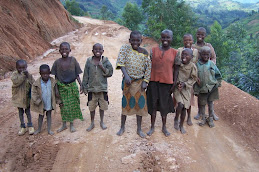
Then I show Mike, Charlotte and Cameron round the older part of Nsanga school. The place sits on a shoulder of mountainside high above the Nyaborongo river, and the views are beautiful in all directions. The weather is becoming threatening and I know from past experience that it can go from burning sun to torrential rain here in a few minutes, so we scuttle as fast as we can back to our car, pursued by the usual bunch of children. Rugendabari is a poor secteur and some of these kids are dressed in absolute rags, ripped, faded beyond redemption. They are almost all barefoot.
We only just make it to the car before the heavy rain starts. I take them down to the river so they can see the Nyaborongo at close quarters. After the recent rains it’s flowing extremely fast, and is the colour of milk chocolate. Once gain there are tons of Rwanda’s best topsoil floating down to the Nile.
Back through the deluge to Gitarama where we eat at Tranquillité and Cameron can try the delights of mélange. He’s very tactful about it, and comments that it’s filling. That’s probably the nicest thing you can say about it, as anyone reading this who has sample it can verify!
After lunch we hare back to Kigali and I leave the officials and plod across the hills to Amani guest house to rejoin the motor cycle training gang. As luck would have it, I’ve missed very little and there’s plenty of food waiting for me there. There’s no water at the moment in most of the rooms, but who needs water if you’ve got a packet of wet wipes?
In the evening I go to the local bar with Ruairi (who I’m sharing a room with). We discover that his father comes from the same part of Ireland as Teresa’s ancestors, and we even know tiny villages like Grange. It really is a small world.
Best thing about today – getting all the little pieces of today’s jigsaw completed. Feeling that we’ve done ourselves justice in showing a visitor what our work is like. Sending Soraya a cheeky text message to say that she’s “passed” her “inspection” as a trainer at Nsanga.
Worst thing about today – nothing. I find to my relief that I haven’t really missed anything on the motor bike course today. Most of what they seem to have been doing is theory and the Rwandan highway code. As a car driver I won’t have to take a Rwandan theory test. Mind you, the Rwandan Highway Code is a hoot. It’s almost a direct lift from the French or Belgian version, but translated into Kinyarwanda and then into stilted English. Some of the phrasing in legalese is amazingly obtuse. And why do all Rwandan drivers have to know the signs for level crossing and ungated level crossings when there’s no railway in the entire country and you have to go hundreds of kilometres into Uganda or Tanzania before you find a line that’s in use? On the other hand, we have to know the rules about driving herds of animals along the highway at night, the rules of how to safely load said animals onto ferries to cross the Nyaborongo, and to recognise the sign which means we can’t push loaded wheelbarrows down particular streets in Kigali. Life is never dull here, nor without its funny side!
Friday, 14 November 2008
Round about Rugendabari

Sunday, 9 November 2008
My new life as a moto driver
 This is me trying to get my coordination together and just about to move off under power for the very first time. It would, of course, help if I was lookign where I was going instead of looking down at the controls......
 My very first attempt on a moto. I've got an instructor sitting on the pillion giving me "help"; but all he's doing is messing up the bike's balance. It was far easier when he decided to get off and run alongside me for a while, shouting instructions. And I'm still not looking where I'm going!
 A happy bunny. Five or six circuits of the playing field; I didn't fall off once, and I got as far as fourth gear.
 Els looking very nervous. But in the end she did the "cones" test better than any of the rest of us. Els doesn't drive a car, so the mysteries of clutch and gears were added to all the general trials of trying to stay upright, not stall, and not run any of the little boy spectators over.
 Hayley's a natural rider, which is all the more surprising because she, too can't drive a car.
Saturday, 8 November 2008
Adieu Nyabinoni - a la prochaine!
November 6th
Final day of training. We feel completely at home here and will be sad to leave. On the other hand, neither of us are particularly looking forward to a long moto ride. So far we haven’t had any serious rain since Sunday; if it doesn’t rain today we’ll be OK; if it comes on a downpour during the morning we could have another horrendous journey.
We finish our training promptly at 12.00; we think we did it better with the second group. Our motos are supposed to be here ready for them, but there’s no sign. Soraya has confirmed the arrangements and they have promised to come.
We go back to the Presbytery. Father Bernard has arrived; he speaks very little English but perfect French so he and I chat for ages. Jean-Damascène insists we stay for lunch, and Claudine has catered for a small army. Sylvère is there, too, to formally thank us and see us away.
We give RwF10,000 each to the priests to put to any use then want in the parish. We also give RwF 500 to Claudine, who has washed my filthy trousers and cagoule so they look like new, and also washed some stuff of Soraya’s. We’re clean little bunnies for the journey home!
The motos eventually arrive at 1.30 – only 90 minutes late. There has been no rain, and the roads are fine. I’m hoping they’ll choose to use the mountain road because the views will be exceptionally clear after the rain, and Soraya has never been up there. But they are adamant they want to use the valley route, so back we go in a shower of dust and gravel.
All through the village of Nyabinoni people are waving goodbye to us. We are so sorry to be going; I am absolutely sure we’ll come back again either for training or to inspect the schools. (Three are Anglican and four are Catholic; with Michael and Tinks we could polish off the lot in a week and stay in luxury at the Presbytery while we’re at it!)
It only takes us 2hrs 40 minutes to roar back to Gitarama; the weather is warm in the valley and we are fine in shirtsleeves. What a contrast to he outward journey!
Back home everyone is incredulous at the story of our epic battle up the valley on Sunday; the talk at the muzungu meal was that we would probably have escaped the rain and arrived at Nyabinoni with little difficulty. How wrong can they have been…..!
The rest of Thursday is spent unpacking, putting stuff to the wash and doing my ironing, and generally relaxing.
Its nice to be home with all the comforts of the flat, but Gitarama feels noisy and jarring after the peace of the far north.
Best thing about today – feeling that we’ve done a worthwhile job; knowing that we’ve made friends in Nyabinoni; knowing that we’ll make sure we go back there before we finish our time in Rwanda.
Village life, big winds, and crinkle cut chips!
November 4th and 5th
The pattern for both of these days is the same. Up at just before 6 and off to mass with Jean-Damascène at 6.30. On both days he has around 50+ in the church; slightly different people each time. The singing is different each day, but always loud and a bit raucous.
On Tuesday we finish at lunchtime, so we have the afternoon free. We decide to go for a good walk; the long evenings and early nights mean we can’t do anything after dark so we have to make the most of the daylight.
In the early afternoon, on both days, there is a tremendous wind which comes down off the Ndiza mountains. It really is impressive. The eucalyptus trees outside the presbytery are bent over at a crazy angle; dust is flying through the air; leaves and twigs twirling around the ground. In the distance, because up here we can see for dozens of miles, there are at least two or three separate thunderstorms crashing and rumbling around the hills. None seem to be coming our way; we get a few spots of rain but nothing more.
We decide to walk to Gitumba along the road on which we arrived. By now the mud has more or less gone and it’s easy walking. Simeon, the school caretaker, comes with us; he can’t believe that muzungus can go for walks for pleasure. Jean-Damascène has another friend round; this time the priest is teaching him how to ride a moto. Half way between the two villages we come across the guy; he looks very confident for someone who is only a beginner. Perhaps I, too, will find moto riding easy after all!
We pass loads of people; the children all want to come up and shake our hands; the older people invariably greet us. It’s just the teenage girls and young women who eye us a bit warily.
We pass lots of felled trees, and a makeshift sawing frame where two very muscular woodcutters are sawing a massive eucalyptus into planks for building. They mark out each individual plank first using either charcoal or a thick pencil. The tree trunk is balanced on other pieces of timber on the steeply sloping mountainside. (I wish now that I’d taken a photo). Instead of sawing the planks one at a time, it is more manageable to cut every plank for a couple of feet along, then shift the tree trunk across the timber supports and continue for another three feet or so with each plank. It’s backbreaking work, and whoever is sawing underneath gets all the sawdust over them.
Eventually we come across Jean-Damascène. He shows us one of the two rivers running each side of Nyabinoni; he has big ideas to put a micro-hydro scheme in place and provide electricity for the entire village. I think the stream he shows us is far too feeble for that, but judging by the sound of rushing water, the stream on the Bubaji side of Nyabinoni would be a good proposition. Oh well, once his new church is completed I don’t doubt that powering Nyabinoni will be his next big project!
At one point in our walk there are a flock of tiny, wren-like birds flitting from bush to bush not more than six feet in front of us. And a water bird is calling deep down in the ravines from one of the streams there. The road is lined with eucalyptus trees all the way to Gitumba. It winds and twists round spur and round gulley and takes at least twice the straight line distance. Communications up here really are an issue. There can be no meaningful outside investment, no job creation, no significant improvement in living standards until the roads are paved or at least made into sensible all-weather propositions. Everybody knows this; the problem is that Rwanda is too poor and there are so many roads. And, of course, the hilly terrain makes road building expensive and complicated.
At Gitumba we stop when we reach the secondary school; we go into its grounds because the visibility is pin sharp in the evening light and we suspect we’ll get a good view across to the volcanoes. We’re not disappointed – all thee main volcanoes stand out sharply. But it’s already too dark to get a worthwhile photo.
While we’re looking at the view the school stockman comes out to greet us, and his retinue of wife, daughter and various relatives. Fortunately he speaks good French so I introduce us and say why we’re here. He tells me there is a teachers’ meeting in progress inside and do we want to meet the head. We gently decline, and set off back home.
Long before we get back to Nyabinoni it has gone completely dark; once more we are tramping along dark roads in the night. There are still plenty of people to meet and greet along the way, and we are caught up by the school bursar from Gitumba who lives in Nyabinoni and wants to know what we were doing in “his” school. He speaks English, and soon we’re chatting away so the miles soon fall away.
At Nyabinoni it’s seven o’clock; the bars are already doing brisk business. There has been some sort of public meeting during the late afternoon; the village square has been jammed with people and these are now dispersing back home.
Having walked to and from Gitumba, both Soraya and I now have a healthy respect for the distances these teachers walk to get to and from our training sessions. Those from Shaki have twice the distance to go, and those from Ngaru and Kibingo have around twenty kilometres. No wonder they often arrive late and in a much sweat. I’m never going to criticise rural teachers for arriving late again!
On Wednesday afternoon we again go for a walk, this time straight up the mountainside on the road which leads towards the ridge route. We don’t make it all the way to the top; we get about two thirds of the way there. It’s enough to give us super views of the whole length of the river valley.
Part way up the mountainside we meet Simeon, who’s chatting up a couple of girls by the entrance to their hut. But hanging around with the muzungus is much more interesting (he can talk to the girls any day), so he tails us up the hill and back down again.
On Wednesday we once more have the strong winds during the early afternoon. It must be something to do with convection currents of hot air rising up from the river valley, and cold air from the mountain tops descending to fill its place. The classroom we’re using has the blue thin metal roof; the roof panels flap and strain mightily. It’s difficult top concentrate against all the noise.
While waiting for tea I meet Françoise. She is the secretary at the Nyabinoni umurengi office – the parish office, and is the equivalent of a mayor at village level. She’s intelligent, no-nonsense and speaks very good English. She tells me she went to college with Yvonne who is now the mayor of all Muhanga District and a real power in the land (and whom I met last Friday). She already knows who we are and why we’re here – there’s a well functioning intelligence system in operation – but she’s very pleasant. She says just about everyone in the village has talked to her about us; they want to know what we’re doing and how long we’ll stay. I would guess that Françoise is one of the very few people here besides the priests who have received any sort of higher education. I wonder what she makes of having to live in this beautiful but remote place.
For evening meal Claudine serves us a banquet. Crinkle cut chips have reached Nyabinoni, so there! And her soup, and tomato sauce for the main course, are unmissable.
After dinner its early to bed because I’ve finished reading my book. Thank heavens I brought my iPod. In the silence of Nyabinoni the music sounds great; I fall asleep still plugged into to Congolese hits. Not even the dished bed boards can stop me sleeping; I think the cumulative effects of lots of fresh air and three days’ training have tired me somewhat!
Best thing about today – just the feeling of being accepted into a Rwandan community. Gitarama is too big; you don’t get to know enough people. Here everybody knows who we are; most people have greeted us, and we feel absolutely secure.
entertaining Claude and Immaculee
 Claude and Immaculee came round for supper last night (at Soraya and Hayley's house). Soraya did the main course, I did the puds. Immaculee is eight months pregnant. I'm wearing my new green shirt; I only picked it up from the seamstress this afternoon!
O K, here's some good news from Rwanda
 Any of you readign this who have been to Gisenyi will have seen this contraption. It is anchored a few miles off shore and from Gienyi looks at first sight like a chunky lighthouse. It is actually a drilling ring and storage tank to access the millions of tons of methane which are trapped in layers of water at the bottm of this (extremely deep) lake.
Well, at long last they have started to properly use this gas to generate electricity. Previously the only use for it was to heat the brewery at Rubona - your Primus and Mutzig used lake gas to sterilise bottles and actually make the beer.
Here is an article from today's "New Times" describing the event. Good for Rwanda - saves a few millions of francs on imported oil!
"Finally, Rwanda’s dream of generating electricity out of methane gas has been realised with the first 1.8 megawatts channelled to the national grid. So far, the power extracted from Lake Kivu can supply the whole of Gisenyi District or more. “This is a memorable day in the history of this country; we have finally succeeded in extracting methane gas that has been in this lake for thousands of years and today Rwandans are consuming electricity generated from it,” State Minister for Energy Eng. Albert Butare said excitedly at the mini-launch of the pilot methane gas plant in Rubavu district."
BTW, what exactly is a "mini launch"? I thought it was a small boat.........
The most recent reports from Goma

A CONGOLESE WOMAN REFUGEE'S ACCOUNT
The fighting began near our home in the middle of the night. It was 0300 [local time/0100 GMT] when we heard the first gunshots. There was a lot of gunfire and 'mabombi' - explosions [shelling]. Some people were caught in the middle of the fighting. I saw them die; and after seeing them I knew we had to run away or else we would also die with them.
At least it happened in the night because we were all together, sleeping in our home, and so we were all in the same place and so we could all leave together. My husband and our four children and myself left our home.
We all ran helping and carrying our children - there were very many of us running away.
The soldiers told us it was Laurent Nkunda fighting against the government but I cannot be sure. I do not know exactly who it was because we did not see them all. The only ones we saw were soldiers from the national army. There were so many of them passing by our homes that night. There was no time to pack or even pick up anything to take with us because we were caught unaware by the war beginning again. I left everything else.
We ran through the night in the dark for a long time. The road was bad - it was rocky; and we suffered until we arrived at this camp. It is very far from our village - we walked about 20km. We arrived with nothing but ourselves but I thank God that my family are all together. We are sleeping outside. It is raining a lot. Life is desperate at the camp; we are going through a very difficult time. We keep being told that they [aid agencies] are bringing us food but up till now it hasn't arrived and so we haven't got any food.
The father of my children has been going to look for some work to do in Goma [almost 10km away] and so if he finds work he buys some food for us but if he doesn't, we just sleep hungry.
What I fear most is an outbreak of disease because there are so many of us staying here, all together and so close to one another.
The other thing I really fear is rape because we are sleeping all over. The army could rape us women. Other men could also rape us.
I ask those who are able to, to help mediate so that there can be peace. Peace is our main priority. I would also appreciate some help for all people like me who have lost our belongings. We want to be able to leave these camps and return home and take care of our children.

A curious crowd surges round. Women in vivid Congolese wrappers, babies strapped to their backs; dusty children in tattered clothes. What is the main problem here, I want to know. Hunger, they respond unanimously. We are hungry.
When aid agencies like Save the Children were forced to pull out of Goma because of insecurity, the lifelines to these people were cut. We are trying to get back there as quickly as possible but in the meantime many people have not eaten for days. How were they surviving? Woman were grubbing vegetables from the surrounding countryside, or they relying on the kindness of neighbours.
Shelter here is also a real problem. Many in Kabati have been displaced many times over - a consequence of the warfare that has engulfed eastern Congo for more than a decade. This time, some have at least managed to grab the tarpaulins from their previous Internally Displaced People's Camp before fleeing the advance of the rebels. These sheets have been strung across rickety frameworks of branches or pinned to the side of buildings. A young woman called Bauriki showed me her makeshift home. A muddy floor, a bundle of clothing - it's hardly the kind of place you would want six children to sleep in.
Fear is a another factor. Do you feel safe I asked. No - they shook their heads emphatically. Not far away behind the low lying hills are the rebels. If the negotiations fail and if the ceasefire does not hold, then Kabati camp is on their way into Goma.
Save the Children is launching a major appeal to help the displaced of this conflict. Children are already suffering for diarrhoea, malaria and skin diseases. We are also trying to help families who have become split up in the chaos and to reunite children with their parents again. But their needs are huge and time is short
As the sun sinks beneath the horizon my colleagues nudge me and tell me it is time to get going.
We can get in our car and return to the relative safety of Goma but the the people in the camp don't have that choice. Women and children will be huddled in the fields tonight wondering if tomorrow they will find something to eat.
Children in the 21st century should not be living this way. "