February 3rd
As I walk up to the office today the air is beautifully clear and positively chilly. More like an English spring morning than an equatorial one. By eight o’clock I’m on a moto and off to Munyinya primary school, situated on a hilltop just off the main road to Kigali. The views in every direction from this hill are stunning – row upon row of hills stretching in almost every direction to the horizon, and only missing in the East, where the land gets progressively lower through Nyamata and eventually falls to the swamps of the Akagera National Park.
Lots of people are speaking to me; some making fun of the muzungu who’s travelling on foot rather than in a chauffeur driven car; children are trying out their three English sentences. Somebody calls out from behind; I turn, but before I can answer them I suddenly see on the Northern horizon the entire five Rwandan volcanoes, all absolutely clear of cloud, and all lined up like a row of skittles. In all the thirteen months I’ve lived here I’ve never seen such a wonderful view, and certainly not from Gitarama. If only our flat was on the top of this hill….. (I’d never leave it to go to work!).
Of course, I haven’t got my camera with me.
When I arrive at Munyinya I find a whole group of tronc commun pupils lined up outside a room. They have been allocated places at the school, but there are no teachers appointed yet. (Kigali bureaucracy rather than Muhanga ineptitude at work). So these teenagers (and other pupils who must be in their early twenties), are having to try to teach themselves until staff arrive.
In the other corner of the school I see two brand new water tanks. Munyinya was a prime candidate for one of the Bridport community tanks, but for the second time we’ve been beaten to it by another charity donor, this time a big Belgian NGO. It doesn’t matter, because there will be plenty of other schools for Bridport to donate tanks to. It also means I can get an accurate cost estimate from Vérène, the head teacher. Inflation has raised the prices of everything here by around 10% since last summer, and the value of the pound has gone down about 20% against the Rwandan franc, so what I had budgeted for at £1600 per tank will now cost around £2200, and still rising. But at least I now have some accurate estimates to work from.
I do my usual informal inspection and sit in on two classes. There’s quite a good English lesson with yr 6; the teacher is using songs (action songs), and concentrating on getting the children speaking. This is a welcome change from endless written grammar. He tries doing “vox pop” interviews with some of the children but its hard work and they don’t get beyond the same wretched formulaic phrases. Munyinya’s results for the past two years have made it the quintessentially average school for the whole District; average overall and in each subject’s results. Despite this lack of academic excitement, especially when compared with some of the other Gitarama schools like Espérance’s at Gahogo, parents seem to be falling over themselves to get their children into Munyinya. True, Vérène now has water on site and should have electricity by the end of the year, but for parents prepared to make their children walk up to 5 km to school in tropical heat, there are more academically successful options locally.
The year 4 science teacher is covering agricultural tools, and I worry because other schools I’ve visited were doing the same lesson two weeks ago. When I go through children’s books I discover why. The silly woman is doing a complete repeat of a lesson done a fortnight ago because she daren’t risk losing face by trying to teach something in front of a muzungu and having the children fail to learn or respond. I could crown her – it’s such a waste of everyone’s time. And even then, when she sets written exercises most of the children are getting wrong answers. Even those who are cheating and referring back in their exercise books to the last time they covered this work. Her English is fair, but those of you reading this blog in England would have trouble working out what you did with a “trowa” or to name which artisan uses as “beech”. (Trowel and bench respectively). Funnily enough, she gets “wheelbarrow” just right and I’m spared another session of Mbare’s “wierbollows”.
One sad piece of news – I can’t go into a year 5 class because one of the children’s mothers has just died and the funeral is taking place this morning. The Science teacher is going to the funeral as are some of the children’s friends. Deaths are very common here; of teachers as well as of parents and children; funerals are an everyday event.
I do a debrief with the two teachers and with Vérène; she’s a good head but I tell her that she’s got to pitch her sights higher on exam results. Her facilities are fast becoming the best in Gitarama, but that won’t count for long if her results stay so average.
A quick matata ride brings me back to the district office. Before I left this morning I left my new laptop for Cessie, the ICT girl, to see if she could load a full, up to date version of Microsoft office onto it. (After all, I’m working for the district and I’m employed by them, so there’s nothing criminal in using their office software bought for all the employees). To her credit Cessie has not only loaded it, but it’s a far more up to date version than any I’ve seen. Wow Cessie – you’ve absolutely made my day!! I tell her that she’s got to marry me so my software will never get jaded – there are a bunch of other women in the room (all of whom know me from last term’s English classes), and the whole place falls about laughing. I’ve just about got to grips with the Rwandan sense of humour and that quip hit the nail on the head.
Charlotte’s coming to see us this lunchtime, but has been delayed on route, so Soraya and I go down to Tranquillité for lunch and then arrive back at the office in time to meet and greet. With Charlotte is Andrea, the Canadian girl who placed me here in Rwanda, and her boyfriend. We chat with Claude; Claude’s starting to say he wants me to stay for a third year. I tell him that Teresa might have an opinion on that… Anyway, Claude himself has applied to do a Master’s degree in England next year; if he gets sponsorship from the Government he’ll certainly do it. I don’t know who would hold the fort while he was away, but he and I make a good double act in the office and it would feel decidedly odd to be working with someone else.
During the course of a conversation with Soraya we both realise there have been a lot of changes of head teachers since the end of last year. Nobody, of course, has produced a list of who’s who and their contact numbers. I don’t want a repeat of last Friday’s faux pas when I visited a school only to find there was a new head who wasn’t expecting me and wasn’t on site. We ask Béatrice if she has a list, and she produces the attendance list from the big meeting of ten days ago.
I start going through it and realise that nearly a third of headships have changed. Some have retired, some have been forced to retire on grounds of age or competence (lack of); others have been transferred to other schools. Our friend Étienne in Rongi has been moved to a bigger school. He was in the office yesterday; he didn’t say anything about it to us and we had no idea, so we couldn’t congratulate him. I’m really pleased that he has been promoted, though; he works hard and thoroughly deserved all the success he can get. And he’s staying in the secteur which needs just the level of energy he possesses. Also, around a half of the head teachers have new phone numbers. It’s just total fluke that almost every school I’ve contacted this term has kept the same head and same phone. It’s the schools out in the rural secteurs where the changes are most pronounced. Teachers are badly paid, living conditions are hard, and the lure of easier lives in Kigali means that staff turnover out in the sticks is huge.
So my homework for tonight, as soon as I finish this blog, is to transcribe a photocopy of the head’s contact details so that all the Muhanga VSO contingent can arrange to get to schools. Every time I think I’m clearing the decks of urgent business, another crisis arrives which needs time spent on it. It’s ages now since I had a weekday evening when I wasn’t working till ten at night.
I work late in the office and finish today’s special project, which is a power point for Claude to show the mayor. With my new wizzy office software it’s a breeze until I want to save it and can’t find the “save” button. I have to drag Claude away from his petitioners to come and show me where it is!
Tom’s had another long and gruelling day involving having to replace a car battery; Christi’s been trying to move furniture into her new place and has got caught in today’s thunderstorm which has decided to arrive in the evening rather than the afternoon. Soraya’s got landed with running a training course on Saturday morning. I’m still hoping that the two of us might be able to get across to Epi’s new place in the east; we could go on Sat afternoon and return on Monday morning. If we both work Saturday morning then nobody could criticise us! Problem is – Épi never seems to answer her phone.
Best thing about today - absolutely everything. School visit; volcanoes; computer fixed; task completed for Claude.
Worst thing – where’s my sodding keys? Just how long does it take to get a small package from England to Gitarama? Whose office are they languishing in? Or is some miscreant trying them systematically in every muzungu property in the country…. I WANT MY KEYS!
Thursday, 5 February 2009
"pliz put your trowa on the beech"

Tuesday, 3 February 2009
Water shortages in Gisenyi
 Well, aren't you all glad you're not out here visiting me and on an excusrion to Gisenyi! Gisenyi is the border town with Goma and the D R Congo, and is on the edge of Lake Kivu. Right now we are having very heavy rain every single day. Lake Kivu is one of the great African Rift Valley lakes and an absolutely vast body of water. Yet somehow Gisenyi has a severe public water shortage. The taps have been dry for days all over town. So people are reduced to trekking down to the lake shore to fill their jerry cans. As a result there's a red alert for cholera in the town...
How can we have severe water shortages at the close of the rainy season and when we're next to one of the biggest lumps of fresh water in Africa?
Don't worry; we're all steering clear of Gisenyi for the next few weeks....
Rumblings in the jungle
February 2nd
The situation in the Congo isn’t being reported at the moment in the European media, but is getting potentially dangerous. More and more Rwandan troops are being sent into the Congo; last weekend Joe reported lorry after lorry of soldiers heading towards the southern frontier at Cyangugu/Bukavu as he was travelling in the opposite direction for his and Tiga’s birthday party. We assume the soldiers are going to try a pincer movement with other Rwandan troops coming in from the north at Gisenyi. Officially the Rwandans are there as observers while the Congolese army sets about disarming the various militias, but the Rwanda forces are armed to the teeth and I can’t see them sitting idly by if there’s a chance to flush out old enemies. The situation is highly dangerous. The number of interahamwe still living who are known to have records of genocidal activities in 1994 is quite small. After fourteen years it’s difficult to distinguish between who’s a rebel and who isn’t. If there is serious fighting, then Rwanda will get embroiled in a never ending war. The rebels are adept at guerrilla tactics, and the terrain in eastern Congo is such thick jungle that you could hide tens of thousands of combatants without anyone ever finding them. And, as usual in these conflicts, if the rebels don’t agree to disarm we could be in for a long war with hundreds of thousands of displaced people.
The key to all the guerrilla activities lies in the mines they use to finance their operations. If either the Congolese army or the Rwandans could seize control of the minerals then the rebels would run out of cash pretty quickly.
There’s an awful lot at stake politically here, especially for the Congolese leadership. Congolese people hate the Rwanda army because they have invaded the place twice since 1994, and the Congolese are deeply suspicious about Rwanda’s motives for this third, invited incursion.
The BBC’s doing a pretty good job of reporting the news on its Africa page. There’s very little indeed at the moment in the Rwandan media.
Today I go in to the office and print off a load of statistics for Michael, Sally and Nicole; as the VSO who knows where everything is I feel it’s my duty to give them all the briefing papers they can use.
Then I set off on foot up the road to Biti school. Biti is lovely; a school built onto a paroisse. There is the usual semicircular church, and a block of six classrooms sandwiched between the church and the main road. Biti’s exam results are excellent; 11th out of 93 in this year’s concours. Gilberte, the head teacher, is alarmingly pregnant (it crosses my mind that this could be the first school visit I’ve ever done where the head goes into labour part way through my stay). She is a good administrator and very diligent with her timetabling; of all the schools I’ve visited so far she gives me the clearest indication of how difficult it has been to cover classes with the teaching hours available. As in some of the other schools, Biti has people on ridiculously high contact ratios.
I observe a really good maths class in which every single word – pupil as well as teacher – is in English. They’re also doing real maths – geometry. I enjoy this lesson, and help the teacher by going round and sharing the marking load with her.
At break time I speak to all the staff in the staffroom (yes, this school has a head’s office and a full-sized staffroom. They are rooms owned by the catholic church and built onto the rear of the church itself, and so can’t be requisitioned by Kigali to house a tronc commun section at the school). Gilberte and her PTA has even bought a parcel of land next to the school with an eye to building three more classrooms, originally for anticipated growth in the yrs 1-6 section of the school, but now crying out for a specialist block for tronc commun pupils. All it needs is a wealthy benefactor to stump up the building costs. (Don’t look at me, that’s what I say. I’ve had enough of building projects for a while).
After break I watch an English lesson. This is a highly experienced and trained male teacher. He has amazing energy, and starts with an action poem. He has all the children taking part in the lesson, which becomes a list of personal pronouns (subject and object). Unfortunately, when he sets exercises towards the end of the lesson the children patently haven’t learnt what he intended them to, and he’ll need to revise the whole lesson when I’m safely out of the way. He’s embarrassed about this, but there are just some lessons when, despite whatever preparation you do, you can’t win.
At lunchtime I meet up with Hayley, and Charlotte, and also Yelena who is a Serbian girl working for the YWCA. I’m supposed to be visiting Nyabisindu school in the afternoon, but the sky is inky black and it looks as though I’ll get soaked if I leave the office. I even take a moto back to the office because I’m sure if I try to walk all the way I’ll get drowned! So I stay put at the D O; in any case Claude wants me to help him with a report on the primary results for the mayor, and I’ve borrowed his modem to update my virus checker.
Late in the afternoon Nicole arrives; I’ve got loads of paperwork to give her and more to pass on to Sally. Claude is having difficulty trying to use the cut-down version of excel spreadsheets on my computer, and we go to talk to Sessie, the ICT girl in the office. She has back-up disks for windows vista and we think we can upgrade my laptop tomorrow. (Must remember to save stuff to my external hard drive tonight just in case of disaster). But I can’t go on for much longer with this silly apology for an excel package; I’m really cross with myself for not twigging that I was buying a cheap and nasty version.
Back home feeling rather sheepish – the expected storm never got beyond a gentle rain, but the clouds were absolutely inky at one stage. I’ve seen dire reports of snow and chaos back in England; apparently they’ve even seen the odd snowflake in Dorset which is a turn-up for the books! In the office our power’s been on and off all day; one good thing about my new laptop is that the battery life is pretty good and I can ride out all but the longest power cuts and keep working.
We use a recipe from the VSO cook book and make a huge batch of red lentil daal; Tom has some chappatis which can double as poppadoms if we dry fry them, and the result is a simply enormous meal.
Monday, 2 February 2009
Eight nations for supper in Gitarama
February 1st
I’m sure I’ll sleep like a log after yesterday, but things don’t work out that way. I’m awake at five, at dawn. The hotel is only a few hundred yards as the crow flies from the Faucon and its nightclub, and the club is still going strong. The thudding of the bass speakers travels through the ground and beats inside my head, waking me up and then not letting me go back to sleep.
Finally, at six o’clock, the nightclub finishes and the revellers go home. I’m just drifting back off to sleep when a church nearby opens up with the full works – drum machine, raucous, monotonous singing, and prayers delivered in a hysterical, shouted rant that sounds vaguely like something from China’s Cultural Revolution. It sounds nothing like worship or, at least, nothing like my concept of worship. Here in Rwanda there doesn’t seem to be any practise of silent worship; nobody seems able to use silence as a means of devotion. Every second has to be filled with noise.
By eight o’clock I know that any further sleep is impossible, so I get up. To my relief and surprise the dining room is full of VSOs who’ve had exactly the same problem. We enjoy a leisurely breakfast and a chat, and then it’s off back home to Gitarama on a comfy bus. Today’s the day all our phone numbers change in Rwanda, and I pass some of the journey time changing all my numbers. Let’s hope the system works properly. (As I’m writing this on Sunday evening I’m happy to say that, yes, the new system is working well for in-country numbers. I wonder if Teresa will have trouble in getting through from England in a few minutes’ time).
I had originally intended to stay in Butare and come home in the afternoon, but it seems silly to waste time in Butare just for the sake of it when I’ve a lot of work wanting doing back home.
Today is “Heroes Day” and a public holiday (even though it’s a Sunday). This is the day last year when Tom and I spent the morning in Gitarama stadium and saw the President. I don’t know where Kagame is today, but he’ll probably be in one of the other provincial towns. Every town we pass through on the way home is holding a ceremony, with dancers, drummers and long, long speeches. At Ruhango the crowd has fanned out to seek shade from the relentless sun under wild fig trees by the roadside. Down in Butare all the local secondary school children (boarders) have been dragooned into attending and are marching through the town towards the stadium, banners at the ready. I don’t miss not being at a ceremony today; I think if you’ve been to one of them at some time, then you’ve been to all of them. They all follow the same format. Throughout the journey home we are listening to a Kigali ceremony on the bus radio and it brings back vivid memories of last year under a hot Gitarama sun, waiting and waiting for the President to turn up, and then feeling excited when he did a lap of honour at the stadium and passed within a few yards of me.
By two o’clock I’m in the flat and proof reading Védaste’s MSc thesis. It’s all about the effects of different kinds of mulch on coffee trees and the soil around them, and since a lot of it is about rates of soil erosion and methods of countering soil loss, it runs very close to things I have studies a long time ago in geography.
One chunkVédaste quotes is so stark that I’m reproducing it here for you: “In Rwanda every year it is estimated that fifteen million tons of soil are lost due to soil erosion. This is an amount equivalent to the soil necessary for feeding 40,000 people”. So every time I cross the brown Nyaborongo river I’m going to be thinking about how many people’s soil is washing away beneath me on its way to Lake Victoria.
Védaste has made loads of mistakes – word order, vocabulary, phrasing, as well as general typos. I spend the whole of the afternoon until six o’clock going through his thesis, but at last it’s done. I’m really please; it would have been an albatross round my neck if I had left it till the weekdays, and despite having spent all my Sunday afternoon at work, I’m relieved that at least it’s one item done and dusted.
(And part of me wants to take Friday afternoon off next week and travel down to see Épi if she’s installed herself in Kibungo. If it comes to pass, then I’m not going to feel guilty about skiving off a half day if I’ve worked all Sunday afternoon).
The muzungu meal in the evening draws a huge crowd, and even then we are missing several people. Myself and Tom and Christi, Hayley, Soraya, and Charlotte, Nicole and Sally, Moira, Michael, a new friend called Michel (French Canadian) and his Peruvian wife; Marin, Piet and a friend of his from the hospital. We have American, Canadian, British, Belgian, Peruvian, Philippine, German and Irish volunteers. Because we’re such a big crowd we have to wait for ever for our food to arrive. There’s a massive thunderstorm outside with violent lightning and heavy rain; we keep having to squash tighter together under the awning so that those on the outside edge don’t get wet from splash back from raindrops the size of marbles which are banging down on the roof above us.
By the time we get home my carousing and lack of sleep from Saturday are catching up with me. A quick slapdash version of the blog and bedtime here we come!
Best thing about day - being able to say I’ve repaid Védaste’s kindness to me by proof reading his thesis. You wouldn’t believe the number of corrections I’ve made to smooth the English phrasing! It’s been a good Sunday and it’s nice to go to bed feeling Ive achieved something worthwhile.
Best thing about today – being able to feel that I’ve repaid
Murambi Genocide Memorial Centre
 (Double click on this to expand it to a usable size).
Murambi Genocide Memorial Centre, and Tiga & Joe's birthday party
January 31st
A tricky day today in terms of logistics. Its umuganda, and buses won’t be running after about 7.30 in the morning, so I get up early as if it’s a work day and by seven I’m on a little matata chugging down the main road to Butare. I reach Butare by nine, and book into the Ineza hotel. (I need to make sure I’ve got a room for tonight because if there are loads of people coming down for the party, rooms will get taken quickly, so that’s another good reason for getting down here as fast as possible).
By half past nine I’m sorted, and have the rest of the day to kill before Tiga’s party. Umuganda has started; the shops are shut and the roads are emptying fast. I drift up to the corner where the road to Gikongoro road leaves the main road and have to wait quite a while until a driver is willing to brave the enforcing police and take a busful up to Gikongoro. While loading, the bus is sneaked down the museum entrance drive so that it’s half hidden from the main road. The driver is adamant he’s not going to leave without a full load, and the bus is getting rank with everyone’s BO under a blazing hot sun.
Eventually we get to Gikongoro and I walk a mile or so down a leafy, shady lane to Murambi.
Murambi is one of a handful of most awful genocide sites in Rwanda. Around 50,000 people were slaughtered at one go in a frenzy of senseless murder. It took four days to kill them all. This was no senseless spontaneous act of recklessness, but calculated genocide.
Murambi was a brand new technical school, still under construction in 1994. It stands isolated on a hilltop with beautiful views in all directions. It seems an odd place to put a school – more than a mile from the town it serves and in the middle of nowhere. There were blocks of classrooms ready to use, and dormitory accommodation for the students.
In 1994 anywhere between 40,000 and 60,000 people - mainly Tutsis but also some Hutus – were assembled at the school site, supposedly for their own protection. But the interahamwe militia had other ideas and attacked them. Murambi is on a bare hilltop. If you attack it, there are no woods to hide in; no cover of any sort to help your escape. These people were caught like rats in a trap. Hand grenades were thrown through the windows, and the slaughter went on. And on, and on.
Now the school is an empty, eerie shell. Many blocks are roofless and windows gape empty. Part of it reminds me of the brick buildings at Auschwitz. At the entrance there is a shiny white reception centre with conference rooms and dormitory space for visiting school parties to sleep. The guide welcomes me and shows me round personally. One solitary Israeli youth is just finishing his visit; we exchange a few words, and then the whole place is mine.
The guide takes me to a classroom block. These rooms are roofed, windowed, and with locks on the doors. But nothing – nothing – prepares you for what’s behind the doors.
The classrooms are bare; walls are in grey plaster. Any traces of bloodstains, or shrapnel marks from grenades or bullets have been smoothed out. Inside the room, to the left and right of a central passageway, are white wooden benches about two feet high. These benches are covered with mummified bodies. Some are stacked on top of each other like firewood, but most are laid out singly. Each room has a small bouquet of flowers; again there are parallels to those in the gas chambers at Auschwitz.
The bodies were covered in lime immediately after the event. While the flesh has rotted away, the skin is preserved. In some cases there are tufts of hair visible. Most have been buried naked, but except in very few cases it is impossible to tell whether they are male or female. About 60% of the bodies are children; some of them very young children. The skin is bleached white; the same colour as bone. A few bodies still have their clothes on them. One young boy is wearing his school shorts, exactly the same kind as I saw on the children at Kivumu yesterday. One woman has a long skirt. Someone else has a woollen sweater with the colours almost faded to oblivion but just about recognisable.
Most bodies have enormous gashes on their skulls. These people were killed with machete blows. It would have taken several hard blows to be sure of killing a fully grown adult. The ribs have sunken down to rest on the top of the spine giving each body a curious, comma-like shape. Many, many bodies, adults and children, have their arms raised in gestures of protection against the deadly rain of machete blows. Whether this is rigor mortis from the moment of death or an effect of the liming of the corpses, I don’t know. One or two adults are protecting their modesty; these were certainly naked when they were killed and very probably adult young women; you can draw your own conclusions as to why. Some skulls are cleaved entire in half; others have huge portions gone.
There is no smell of death or decay, just a curious musty odour. Scattered over the bodies are what appear to be huge mothballs; whether these are dehumidifiers or something to scare away vermin, I cannot say.
The whole thing is just unbelievable. It looks like the kind of scary set you’d expect from a sci-fi film or horror video. You have to remind yourself that this is for real.
I didn’t take any pictures.
At Auschwitz all you see are empty rooms. You know the statistics, and there are rooms with hair, clothes, suitcases etc, but the dead themselves are gone. You have to try to use your imagination. Here at Murambi the dead are still present. The whole experience is just so stark, so immediate, so close that it’s difficult to know how to react.
My guide takes me into four rooms, all similar, all covered in bodies. These are only a tiny fraction of the numbers who died here. After four rooms he asks me if I’ve seen enough. I have; and few people venture beyond these four rooms.
There is no attempt to sanitise the bodies; the effect is as if they have just been pulled from the ground in the last few days. There is nothing in writing; no display panels of information – nothing. The bodies do the talking themselves. Everybody who comes here knows what they’re coming to see, and the sheer starkness of the remains is amazingly powerful.
The guide leads me away across the school grounds, past birds singing and the rustle of wind through the grass, and into another building. Here they have preserved the clothes from bodies. Racks and racks and racks of clothes, of every colour. The clothes are rags – old, faded, filthy. They were worn by people who had been on the move for days, running from one unsafe temporary place of shelter to the next. Probably unable to wash or relax; always fearful that the next hour would bring their betrayal and death.
Then we move on to the second aspect of Murambi, and one which helps explain the terrible tenseness of French/Rwandan relations. Towards the end of the three month genocide the French intervened with a military force in an exercise called “Operation Turquoise”. The idea was to separate the warring sides; in particular to separate the Hutu army and militia from Kagame’s liberating forces. The French presumably came in with good intentions, but the effects were disastrous. By holding Kagame’s forces at bay for weeks, they allowed the interahamwe free reign to kill Tutsis inside the French held region; many thousands of people died who would almost certainly have been spared if Kagame’s army had been allowed to advance unchecked. The French were in effect supporting the existing Rwandan government, which became the losing side. History is written by the winners, so France became – and still is – the villain whose blundering intervention cost Rwandans dearly.
The French used Murami as a barracks. It is easy to see why. It is easily defendable by a group of soldiers, and a sneak attack on them would be extremely difficult. They used classrooms as dormitories; erected the tricolour in the middle of the school site, and used a level patch of ground as a volleyball court.
Except that the volleyball court is at very least adjacent to, if not actually on top of, enormous trenches filled with thousands of bodies. This act of using a mass grave as a recreation site continues to incense Rwandan feelings; they see it as deliberately insulting and insensitive, and proof that the French were biased in favour of the murderers and against the victims.
At the end of my visit I sign the visitors’ book and write a comment. What is there to say about such a place? I think of pictures of Palestinian bodies - especially children – in Gaza after the latest Israeli rampage and wonder if people will ever learn.
Few people visit Murambi; Hayley and her mum were here last week and there have only been about ten people since then.
I’m glad of a stiff walk uphill back to Gikongoro to distance myself from Murambi and come back to the land of the living. The sun is exceptionally strong. I’m feeling hungry, and in the middle of Gikongoro there’s a place which does brilliant brochettes and ibirayi. Umuganda has just finished, so I go in and enjoy a cold beer and listen to my iPod for an hour while they cook me some lunch. Unfortunately I underestimate the strength of the sun and get seriously burned before I think to get under cover.
Back in Butare I do some shopping, then go to the hotel and have a long siesta. The combination of beer and sun has given me a throbbing headache, not helped by a pounding bass line from the ubiquitous sound system in the hotel garden.
Soon there’s a collection of VSOs gathering up ready for the party, and we descend on Matar. Matar is Butare’s Lebanese supermarket with a café attached. It’s very popular with all the VSOs and we are on first name terms with the three brothers who run it. It’s rather like having your birthday party in Tesco’s canteen while the shop’s open for business, but funnily enough it works really well. There ends up over thirty of us, and we bring a lot of trade to the shop. You can imagine how bemused the Rwandans are to see such a massive number of muzungus all gathered in one shop; for the non-VSO whites who come in to do some shopping there’s simply amazement. (“Where the hell has this gang of muzungus descended from?” is written on their faces).
The party is a huge success. There are balloons on the walls, table decorations; cards to sign; Tiga and Joe have ordered jelly and ice cream for everyone and the shop has made an enormous birthday cake, complete with Roman candle fireworks. Ruairi is taking loads of pictures; I’ll try to get copies from him and post some.
After the party we cross the street to the Hotel Faucon and wait an hour or so until clubbing time. The nightclub is really for students at the national university, but after half an hour’s negotiation they agree to let us in, and at a student rate. I’m by far the oldest person with stamina to go clubbing (the sensible ones have all gone to bed); I’m not sure whether to say I’m a (very) mature student or that I’m one of the lecturers and the others are my class of students.
When we get inside, after all that haggling, there’s a distinct lack of music. There’s u/v light; there’s a disco ball; the bar’s in full swing. But no music (and very few other people besides ourselves). We give the manager more grief and he tells us the DJ has got problems with a virus on his computer which is preventing him from playing music. Ha ha – the dreaded Rwandan laxity with virus checkers has come home to roost. We say we’ll give him five minutes and then demand a refund and go somewhere else. Four minutes and fifty nine seconds later the sound system burst into life. We dance like crazy until half past one, when we decide we’ve all had enough. Now at Cadillac in Kigali you seem some pretty good dancing, but these young students are just out of this world. The men as well as the women. We gradually move away from the centre of the dance floor and keep to a dark-ish corner, boogying away but with one eye on the impressive contortions these Rwanda are doing in time to the music.
After the heat of the day, the night air is cool. My room seems free of mosquitoes so I dispense with a net and keep a can of Deet by my bed, just in case.
Best thing about today - ???? It’s not been an experience that you could describe in terms of good or bad. But both parts of the day – Murambi and the party – have been thoroughly worthwhile.
Agnes's retirement do at Kivumu
January 30th
Today I’m fed up with statistics and want to get out and visit a couple of schools. But I’ve been so preoccupied in the past few days that I haven’t got round to organising anything (and even if I had, on past experience it would all have to be changed the next day). So I drop off some District papers at the office and find a quiet place in the D. O. compound to ring schools. Five phone calls and about 600 francs worth of air time later, I’m getting sorted.
Gilberte at Biti puts me off saying she’s not at school today, but she can do Monday. Florent at Nyabisindu also agrees to Monday afternoon, so at least that’s a full day sorted for next week; two schools within walking distance. Vérène at Munyinya will see me on Tuesday; Munyinya is a prime candidate for one of the Bridport community’s water tanks and therefore this will be an important visit. In the afternoon I will try to do Gitarama primary and walk home afterwards. Edith at Mushubati is going to a meeting somewhere this morning, but will see me on Wednesday morning. Wednesday afternoon ought to be Remera, whose exam results this year have been little short of catastrophic. I’d like to take Claude with me for that one, so I’ll have to beard Claude on Monday and then ring Christine to confirm. That’s two more local schools; if I take a moto to Mushubati I can walk to Remera and walk home the back way to Gitarama through the fields. See how easy things are becoming in my second year, when I know where everything is and don’t have to worry about getting lost? Final choice for today is Kivumu, a school which is on the extreme edge of Muhanga in the Kigali direction and doesn’t easily pair with any other. I ring Agnès, the head, and ask if I can come and see her this afternoon. She welcomes me like a long lost friend and immediately agrees.
Back to the office routine. This time I tidy up and print off all my exam statistics, both for primary and secondary, and my sheets of comments on them. They’re on Claude’s desk by mid-day. I’m so, so relieved to get that job done. I’m feeling that we need to visit some secondary schools for inspections. There’s a bunch whose results are crummy; most are either in Gitarama itself or at Shyogwe, and I want Claude to come with me so we can do a more thorough job and I can see how he goes about evaluating a secondary.
So what happens next? – I get landed with another huge job. Védaste, the statistician, has just finished his Master’s Thesis and wants me to proof the English. His English is just as creative as my French, so it’s a massive job. We print off a copy of the body of the text, but I spend at least 40 minutes just smoothing and re-phrasing the introduction and credits. It’ll take me at least a week to do the rest. I can’t really refuse him, because it was Védaste who helped me with the French commentary on my big primary census report last year. Oh well, it’ll be a new experience for me. At least people trust me enough to want me to help them.
We have some university students on a sort of work experience placement in the District Office. One of them begs me to let him borrow my flash drive for the morning. I’ve only just finished cleaning it up after Védaste borrowed it; it came back with four viruses on it including a version of the dreaded “Raila Odinga” virus. Fortunately my virus checker is up to date; it tells me it has deleted all viruses but I’m no longer confident that it does. This student promises to bring it back within an hour, but, of course, he doesn’t. I’ll be cross if he thinks I’ve donated it to him as a gift.
The problem with virus checkers is that you can’t win – no single system seems to catch every virus, and if you put two or more on your machine they seem to interfere with everything and slow the computer down to a standstill.
After lunch I take a moto to Kivumu and march up to the school. I ask the first teacher I see to tell the Directrice that I’m here. She looks at me a bit straight and tells me the Directeur isn’t at school this afternoon. Now I know my French is pretty “cassé” at the best of times, but I’m pretty sure Agnès isn’t one to have a sex change job, and begin to wonder what’s going on. After a few minutes all is explained. As part of the general shake up of schools over the Christmas holidays, Agnès was forced to retire. She’s beyond the earliest retirement age (55) but was intending to stay on till about 65. She has been replaced by Idlebald, who was formerly head at Bwirika in the same secteur. (And for HTB readers in Bridport, Bwirika is the place where I first suggested we locate our church-sponsored water tank). Agnès has no doubt assumed that I know she is retired, and is expecting me to call in on her at her house. OK, but I haven’t a clue where she lives.
As I’ve arrived at the school I ask if I can watch some lessons. Fortunately the teachers recognise me from previous visits and training days, and they phone Idlebald who agrees. I watch a very creditable maths lesson in English, then a less effective English lesson (ten year olds who have only got to the stage of learning simple plurals such as cow – cows, flower – flowers). I wish this teacher would stop saying “tones” when she means “stones”. In the maths lesson the dreaded Rwandan interchangeability of “R” and “L” surfaces again; a little tot brings a smile to my face when she pronounces “whole numbers” as “whore numbels”.
At the end of the afternoon Idlebald rolls up and we talk in general terms about the need for English training. I’m getting tired of schools hinting that unless I personally guarantee to them (and therefore nobody else) a large share of my time to teach them English, then there’s no way they can be expected to improve their results.
At the end of the afternoon I’m invited to a meeting which turns out to be Agnès’s retirement do. There’s the teachers, and priest who acts as Chair of the Parents’ Committee (Chair of Governors in an English context), and a group of parents (the committee itself, paralleling our Governing body). What I thought was just a quick fanta and a chat turns into a two hour marathon. Agnès has come down from Kigali for the occasion. It’s lovely to see her, and she insists I sit next to her and we chat like old friends. She wants to know how Cathie’s getting on; she didn’t know Claude was now a daddy; she has been looking for a new job in Kigali but is finding it difficult because she’s not a fluent English speaker and in the new Rwandan order they’re not recruiting high level personnel unless they’re fluent in English.
We have a proper meal, beautifully prepared and served by parents, and fanta. There’s prayers (two, one for the drinks and one for the eats), and speeches, speeches, speeches. I guess I’m going to be asked to speak, and sure enough, I get given a slot. Fortunately I’m used to this sort of thing and have had time to think of some vocabulary, so I thank everyone for their welcome and explain how amazing a coincidence it is that on the day when I decide to drop in to Kivumu out of the blue, it happens to be the day they’re saying farewell to Agnès. I praise Agnès as their departing head, hard to replace, wise and hard working and intelligent and humane; I praise Idlebald as an experienced new leader in whom they can have confidence; I praise the teachers and tell the parents that those I’ve seen today are competent and hard working; I praise the parents, saying that without their co-operation the school can’t move forward. I remember to bring God into it and end up saying that by God’s grace and if we all pull together, we can address all the issues this school faces, and indeed the whole of Cyeza secteur faces. Pretty good, huh? Everything I say’s being translated into Kinya but I’m not sure who’s listening; they’re either answering their phones or slurping up their gravy.
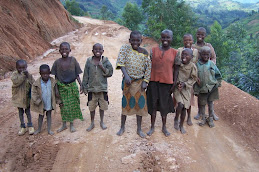
Finally Agnès and I manage to escape together; she’s booked a taxi to take her back to Kigali; I leave her part way up the path and walk through the fields and past the cottages up to the main road. I’m besieged by very poor children filthy with dirt; faces encrusted with snot; ringworm rampant on their shaved heads. They’re dressed in rags; many are barefoot. This the real Cyeza; Gitarama’s just over the far skyline but here you’re a million miles away from its sophistication. The children are demanding money, food, sweets, pens – anything. I don’t have anything to give them; there are just too many of them, and in any case we’re being told again and again that giving handouts to people just encourages a mendicant mentality. But it’s hard. This is one of the most desperately poor parts of my district. Some of these toddlers won’t make it past their fifth birthday; malaria or gastro-enteritis or respiratory infections will kill them. Few of their parents are literate; the one thing they’re expert at is reproducing themselves. “We make the children; it’s God who will look after them” is the mantra.
When I reach the main road a taxi bus is passing and it stops immediately for me. I’m grateful to pile in, dry against the thunderstorm that’s banging its way all round me, and escape into the comforts of a luxurious flat, a bottle of beer, and the solace of writing my report on Kivumu and now this blog.
Best thing about today – being able to say goodbye to Agnes; getting out to another school, finishing my stats.
I know it sounds big headed but it occurs to me that in three weeks since I returned I have already visited as many schools as I did in the entire first term I was here, and also done as much stats work as I did in half a term in the spring. I’m sitting here listening to music from Guinea on my headphones, a bottle of Primus by my side and sharing some of my last precious pack of Twix bars with Tom. TGIF; I’m ready for the weekend.